Collecting Tolkien Advance Reading Copies (Proofs & ARCs)
A collector’s guide to rare Tolkien proofs, their history, scarcity, and why advance reading copies represent the earliest obtainable pre-publication states.
In collecting J.R.R. Tolkien first editions, “the earlier the better” remains the golden rule. The first issue of a Tolkien book is always more desirable and more valuable than later impressions. For serious collectors, the ultimate state would of course be Tolkien’s own manuscripts, most of which are preserved in institutional collections such as Marquette University and the Bodleian Library.
While original manuscripts are largely unobtainable, collectors do have access to an earlier stage than the published book: the uncorrected proof or advance reading copy (ARC). These pre-publication states offer a fascinating glimpse into the book before final corrections and production.
This guide explores why ARCs are produced, their history, typical print runs, and why they have become highly collectible among Tolkien enthusiasts. You can also explore available examples in the Tolkien proof copies section or browse comparable material via AbeBooks.
Why are there proof copies (advance reading copies)?
Publishers have long issued proof copies (also known as advance reading copies or ARCs) of forthcoming Tolkien and Tolkien-related books prior to publication for several important reasons.
First, they allow reviewers and periodicals to read the book in advance and schedule reviews to coincide with the official publication date. Early critical attention is essential in building visibility and demand.
Proof copies are also distributed to key buyers who may purchase large quantities of the book, including major wholesalers, chain bookstores, and leading independent booksellers. Their early feedback can influence print runs and marketing strategies.
In addition, publishers send advance copies to authors’ peers and well-known writers, who may provide endorsements. These comments are often used as promotional “blurbs” on dust jackets, in advertisements, and in press materials.
Because of these roles, proof copies represent an important stage in the publishing process. For collectors, they offer a unique opportunity to acquire a version of the book that predates the first published edition, making them highly desirable within serious Tolkien collections. You can also explore current market offerings via AbeBooks.
The history of Tolkien proof copies
Early proof copies were often very simple objects. In the 1930s and 1940s, a typical proof might consist of typeset sheets bound directly into a dust jacket, giving reviewers and publishers a sense of how the finished book would look before hard covers were added.
This approach had one clear advantage: it closely resembled the final published book. The disadvantage was timing. By the time such proofs were ready, the regular edition was usually close to completion, leaving only a short period for advance review and promotion.
With the rise of large-scale paperback publishing in the late 1930s and 1940s, some publishers began to see the value of producing separate paperback proof copies before publication. These could be distributed more easily and used for promotional purposes.
By the 1950s and 1960s, the practice of sending out uncorrected proofs and advance reading copies had become increasingly common. Major publishers routinely produced bound softcover proofs months before publication, a tradition that continues today.
Modern Tolkien proof copies vary from plain printed wrappers to more elaborate advance reading copies with illustrated covers and promotional material. For collectors, these early states offer a fascinating link between manuscript, production, and the finished Tolkien book. You can also compare current examples through AbeBooks.
Unit costs and quantity of Tolkien proof copies
The unit cost of proof copies is generally significantly higher than that of a standard printed book. This is due to the lack of economies of scale: while a regular edition may be printed in runs of several thousand copies, proof copies are produced in much smaller quantities, making setup and production costs far more expensive per unit.
Publishers rarely disclose the exact number of proof copies produced, and figures are typically based on observation and collector experience rather than official records. While modern advance reading copies can sometimes be found in runs of a few hundred copies, this should not be taken as a universal rule.
For earlier Tolkien works, particularly those published in the 1930s, 1940s, and 1950s, the situation is very different. Proof copies were often produced in extremely small numbers, sometimes as few as 10 to 20 copies, and in certain cases even fewer. These were working documents rather than promotional items, created primarily for internal use, author corrections, or close editorial review.
Later publications, such as volumes in The History of Middle-earth, tend to have more widely distributed advance copies, reflecting changes in publishing practices and marketing strategies. Even so, survival rates remain low, as most proofs were used, discarded, or never intended to be preserved.
For collectors, it is this combination of low production numbers and poor survival rates that defines the true rarity of Tolkien proof copies. The earlier the book, the more likely it is that only a handful of examples remain in private hands, making them among the most elusive items in the Tolkien collecting field.
Why are Tolkien proof copies collected?
The primary reason Tolkien proof copies are collected is simple: they are rare. Unlike standard editions, which were produced for sale, proof copies were never intended for the market. They were working tools — used, circulated, and often discarded once their purpose had been fulfilled.
For earlier Tolkien publications, this rarity becomes even more pronounced. Many proof copies were produced in extremely small numbers, sometimes fewer than 20 copies, and occasionally only a handful. Combined with the fact that most were heavily used or thrown away, the number of surviving examples today is exceptionally limited.
Even in cases where larger quantities were produced, such as later advance reading copies, survival rates remain low. Proof copies were sent to reviewers, booksellers, and publishers’ contacts, and were rarely preserved with long-term collecting in mind. As a result, only a small fraction of any original print run typically finds its way into private collections.
This makes proof copies fundamentally different from limited editions. While limited editions are produced specifically for collectors and often survive in high numbers, proof copies enter the market almost by accident — if they survive at all. This unpredictability adds to their appeal and makes them particularly difficult to acquire.
For the serious Tolkien collector, proof copies represent the closest obtainable state to the creation of the book itself, bridging the gap between manuscript and first published edition. It is this combination of scarcity, historical significance, and proximity to the publishing process that makes them among the most desirable items in the Tolkien collecting field.
Why do some collectors argue against proof copies?
Not all collectors are drawn to proof copies. One common criticism is that they lack visual appeal. Many proofs were produced as utilitarian objects — plain wrappers, minimal design, and little of the craftsmanship associated with finely bound editions. However, this simplicity reflects their purpose as working documents rather than finished books.
Another argument is that proof copies are “common.” This perception usually arises during the short window around publication, when advance copies are actively distributed and can appear relatively easy to obtain. For a brief period — often a few weeks or months before and after publication — proof copies may seem widely available.
In reality, this availability is temporary. Once that initial distribution phase has passed, proof copies quickly become difficult to locate. Over time, most are lost, discarded, or remain in institutional or private holdings, leaving only a small number circulating in the market.
This is particularly true for earlier Tolkien works, where proof copies surface only rarely. It is not unusual for certain items to appear on the market just once every few years, if at all. As a result, what may initially seem “common” often proves to be anything but when viewed from a long-term collecting perspective.
J.R.R. Tolkien: THE TWO TOWERS. Uncorrected Proof. Original proof for volume 2 of LORD OF THE RINGS.
Published by Allen and Unwin, London, 1953. 354 pages. Bound in brown paper with paper name and price labels on front. Enclosed in a custom made red leather clam-shell box.
In terms of importance, there are very few Tolkien books which could compare with this proof. Allen and Unwin prepared a small number of these to help Tolkien with revisions while preparing to publish the First Edition of THE LORD OF THE RINGS.
Hammond and Scull are uncertain of the exact number of proof copies created, although they note 'a good guess' would be between 20 and 24 copies. This compares with the 3,250 copies of the English first impression, first edition. This proof is one of the rarest tolkien items of them all.
J.R.R. Tolkien: THE HOBBIT. Uncorrected Proof. Original proof for volume 2 of LORD OF THE RINGS.
Published by Allen and Unwin, London, 1966. 320pages. Bound in green paper with printed name and publisher on front.
J.R.R.Tolkien the Hobbit proofs are very rare to find. This one with tolkiens name misspelled on the front cover. There are only ever a very small amount of these made and very few come on the open market.
Randel Helms: tolkien's WORLD. Uncorrected Proof.
Published by Houghton Mifflin Company, Boston, 1974. 157 pages. Bound in blue paper with printed name, date of publication and publisher on front.
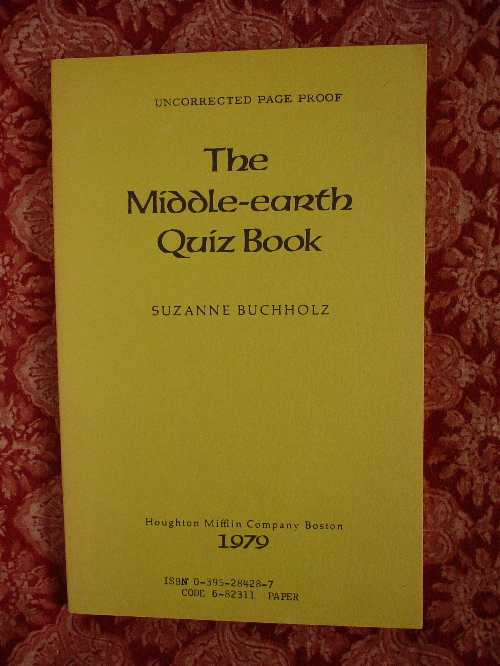
Suzanne Buchholz: THE MIDDLE-EARTH QUIZ BOOK. Uncorrected Proof.
Published by Houghton Mifflin Company, Boston, 1979. 146 pages. Bound in yellow paper with printed name, date of publication, publisher, ISBN and code on front.
This is a typical proof made by crane duplicating. Back then these proofs were called cranes, because of the company who produced them for the publsihers.
Humphrey Carpenter: THE INKLINGS C.S.LEWIS, J.R.R.TOLKIEN, CHARLES WILLIAMS, AND THEIR FRIENDS. Uncorrected Proof.
Published by Houghton Mifflin Company, Boston, 1979. 268 pages. Bound in yellow paper with printed name, publisher and code on front.
A proof from Humphrey Carpenter has become very scarce these days. Prices have risen a lot since the author died.
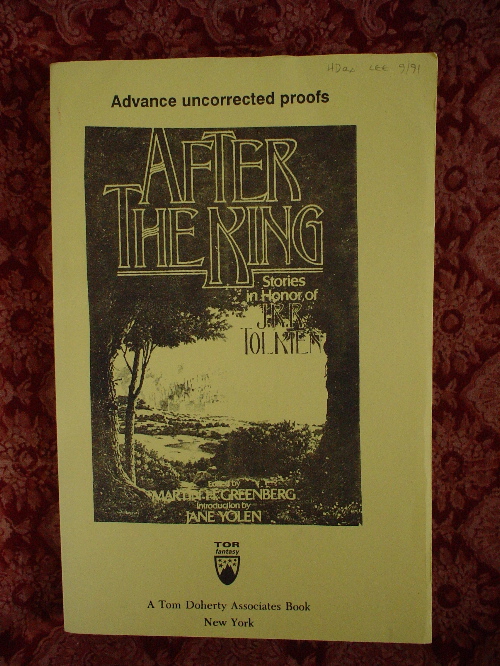
Martin H. Greenberg: AFTER THE KING STORIES IN HONOR OF J.R.R.TOLKIEN. Uncorrected Proof.
Published by Tom Doherty Associates Book, New York, 1992. 448 pages. Bound in yellow paper with printed name, publisher and artwork on front.
Rose A. Zimbardo and Neil D.Isaacs: UNDERSTANDING THE LORD OF THE RINGS THE BEST OF TOLKIEN CRITICISM. Uncorrected Proof.
Published by Houghton Mifflin Company, Boston, 2004. 304 pages. Bound in white/blue paper with printed name, publisher on front.
This is an example of a recent arc. Arc's like these are most of the time readely available. Just keep an eye on all on line booksellers and you will find new arc's like this one monthly!
Final words
When an author, like JR.R.Tolkien, becomes collectible enough, and the author gets famous like Tolkien, it becomes obvious that the proofs are valuable and are desirable additions to a collection. No one would argue that The Hobbit proofs or The Lord of the Rings proofs are not collectibles. In fact they have proven to be very valuable items.
Just to finish of my article. I'm always willing to receive advanced reading copies to preview them at the Tolkien Library. People who have older arc's can always contact me for selling them, i have also some to trade. If interested please contact me here.