Book Collecting Terms: How to Read and Understand Tolkien Book Listings
Tolkien collectors are often confronted with descriptions full of abbreviations, technical terms, and shorthand that can be difficult to understand at first glance.
A typical listing may look complex, but once you understand the terminology, it becomes a powerful tool for assessing rarity, condition, and value.
This guide explains the most important book collecting terms and shows how to read and interpret real-world listings with confidence.
Learning these terms allows you not only to understand listings, but also to recognise when a book is undervalued—or misdescribed.
How to Read a Tolkien Book Listing
Let us start with a typical example:
J.R.R. Tolkien; The Lord of the Rings comprising The Fellowship of the Ring (12th Impression) (F/VF), The Two Towers (9th Impression) (F/-) and The Return of the King (9th Impression) (M/F), published by George Allen & Unwin, 1963, first edition, dust jackets, 8vo, hardback.
At first glance this may seem confusing, but each element provides precise information about the book.
Breaking Down the Listing
- Author & Title — J.R.R. Tolkien; The Lord of the Rings
- Impression — 12th, 9th, 9th printings
- Condition — F/VF, F/-, M/F (book / dust jacket)
- Publisher & Date — George Allen & Unwin, 1963
- Format — 8vo (octavo size)
- Binding — Hardback
- Dust jackets — Present
Once understood, a short description like this gives a surprisingly complete picture of the books.
Edition, Impression, and Issue
- First Edition — The first published version
- First Impression — The first printing
- Second Impression — Later printing from same setting
- First Issue — Earliest version with specific points
- Second State — Corrected or altered version
- Printing line / number line — A sequence of numbers indicating the printing (e.g. 10 9 8 7 6 5 4 3 2 1)
- First printing — The lowest number present is 1
- Later printing — The lowest number indicates the printing (e.g. “4” = fourth printing)
- Reset edition — The book has been re-typeset or redesigned
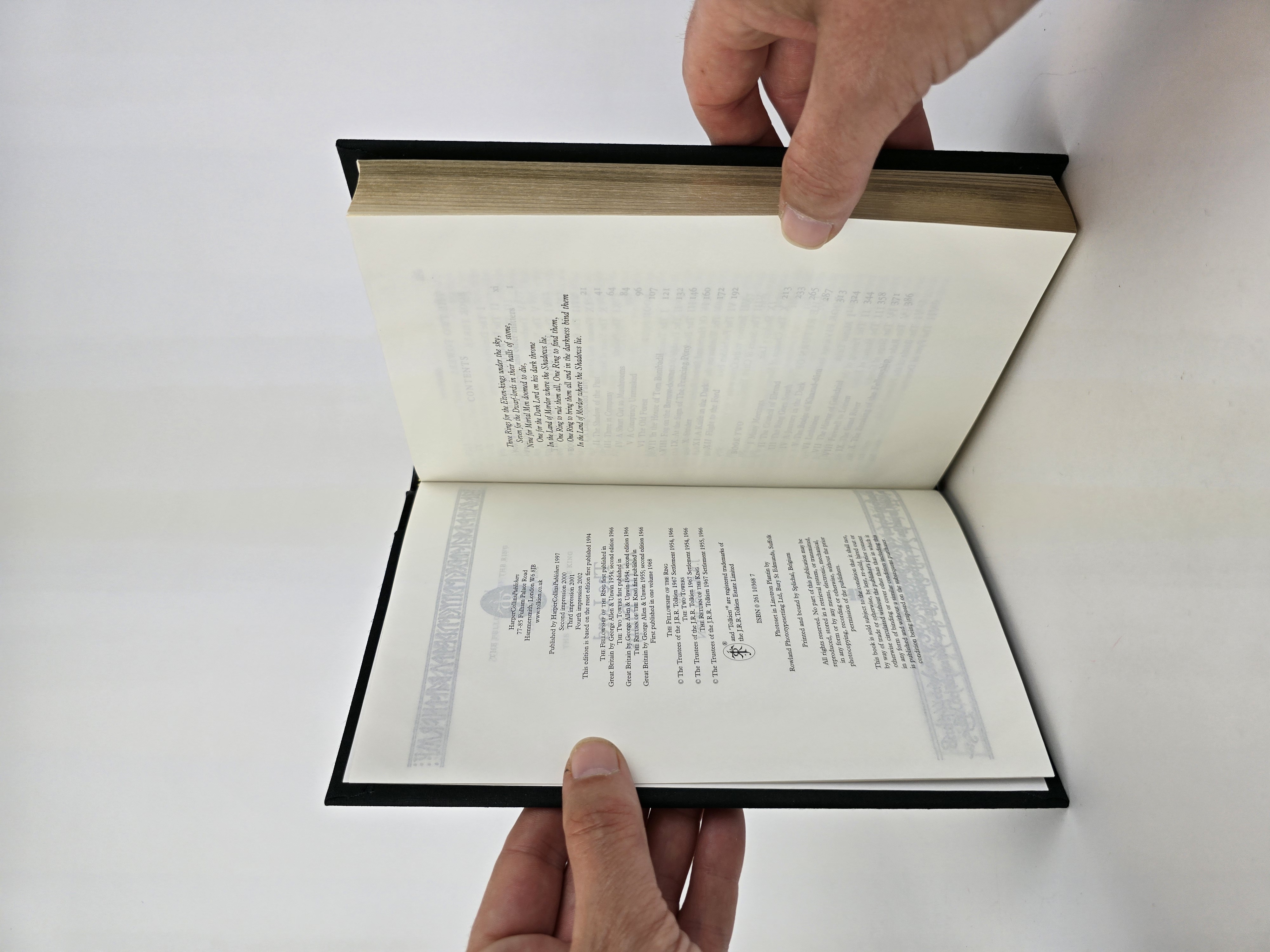
Modern Tolkien books often list multiple impressions beneath the original publication date. Always look for the lowest number in the printing line or the stated impression to determine the actual printing.
A “reset edition” means the text has been re-set in a new format. This creates a new typographical version of the book, even if the content remains largely the same.
See also our guide to grading Tolkien books to understand how these differences affect value.
Parts of a Book
- Spine — The back of the book
- Boards — Front and back covers
- Flyleaf / Endpaper — Blank pages at front and back, often used for inscriptions
- Front free endpaper (FFEP) — First blank page inside the book
- Rear free endpaper — Last blank page
- Title page — Page with title and publication details
- Half-title — Simplified title page
- Dust jacket (DJ / DW) — Protective paper cover
- Flaps — Inside folds of the dust jacket
Understanding these terms helps you interpret where signatures, defects, or inscriptions are located.
Signatures, Letters, and Manuscripts
- Signed copy — Book signed by the author
- Inscribed copy — Signed with personal message
- Presentation copy — Gift from author
- Flat signed — Signature only
- TLS — Typed Letter Signed
- ALS — Autograph Letter Signed
- Annotated — Contains handwritten notes
See our detailed guide on Tolkien signatures for a deeper understanding.
Condition Terminology
Condition is typically described using a grading system. See our detailed guide on grading Tolkien books.
- Fine (F) — Excellent condition
- Near Fine (NF) — Minor imperfections
- Very Good (VG) — Light wear
- Good (G) — Worn but complete
Common Defects
- Foxing — Brown spotting on paper
- Sunning — Fading from light exposure
- Staining — Liquid damage or marks
- Mould — Biological damage (serious issue)
- Price-clipped — Dust jacket price removed
- Restoration — Repairs or alterations
Each defect affects value differently, and must always be described clearly in a listing.
Advanced Bibliographical Terms
- pp. — Number of pages
- [viii], 279 — Preliminary + main pages
- 8vo — Octavo size
- 4to — Quarto size
- Folio — Large format
These terms allow sellers to describe books precisely in a compact way.
In modern listings, you may also encounter terms such as “reset edition” or detailed printing histories. These provide important clues about when a book was printed, even if the original publication date appears much earlier.
Binding and Materials
- Cloth binding — Standard publisher binding
- Quarter bound — Spine in different material
- Full leather — Entire binding in leather
- Morocco — High-quality goatskin leather
- Calf — Traditional leather binding
- Vellum — Historic parchment material
- Spine ribs / raised bands — Raised horizontal bands on the spine
- Foil stamping — Metallic stamping on covers or spine
- Author’s device — Symbol or motif associated with the author
In modern Tolkien collecting, deluxe editions often use fine leather such as goatskin or morocco.
Deluxe Tolkien editions often include detailed binding descriptions. These terms help identify materials, craftsmanship, and design features that may influence desirability and value.
Proofs and Pre-Publication States
Before a book is published, several stages of printing may exist. These are often highly collectible.
- Page proof — A near-final version printed in page format
- Galley proof — Early proof, often in long sheets
- Uncorrected proof — Contains errors before final corrections
- Advance Reading Copy (ARC) — Distributed before publication
These versions can contain differences from the final text and are often rare, especially in Tolkien-related material.
Tolkien Reference Works and Citation Systems
In Tolkien collecting, sellers often refer to standard reference works when describing books, manuscripts, or letters.
These references may appear as short citations with numbers, which can be confusing if you are unfamiliar with them.
- Carpenter (Letters of J.R.R. Tolkien) — Often referenced by letter number or page
- Hammond & Anderson (Descriptive Bibliography) — Entries are numbered (e.g. A6, B12)
- Hammond & Scull (Companion & Guide) — Used for detailed references and chronology
These systems allow collectors and dealers to identify specific editions, letters, and variants with precision.
For example, a reference such as “Hammond A6” points to a specific entry in the Tolkien bibliography, which can be looked up for detailed information.
Collector’s Insight
Learning to read book descriptions is one of the most valuable skills a collector can develop.
A short line of text can contain everything you need to know—if you understand how to read it.
With experience, you will quickly recognise when a listing describes something ordinary—or something exceptional.
Book collecting terminology may seem complex at first, but it quickly becomes second nature. Once mastered, it allows you to navigate the market with confidence and precision.
Understanding how to read listings is the first step towards recognising rarity, condition, and value—and ultimately towards building a meaningful Tolkien collection.
Frequently Asked Questions
What does “first impression” mean?
The first printing of a book. In Tolkien collecting, first impressions are usually the most valuable.
What is the difference between a signed and an inscribed book?
A signed book contains only the author’s signature. An inscribed book includes a personal message, often to a specific person.
What does “8vo” mean in a listing?
It refers to the size of the book (octavo), a standard format used in many Tolkien publications.
Why do dealers use abbreviations?
Abbreviations allow sellers to describe books quickly and precisely, especially in catalogues and listings.