Philologist, author, mythmaker, and creator of Middle-earth
J.R.R. Tolkien was a professor of Anglo-Saxon at Oxford University, a brilliant philologist, and a self-described “hobbit.” He created two of the most beloved stories of the 20th century: The Hobbit and The Lord of the Rings. These works, recently adapted into award-winning films by Peter Jackson, and newer adaptations like The Rings of Power, have brought his creations to new generations. The Lord of the Rings and The Hobbit have been translated into over 70 languages , making Tolkien one of the most widely read authors of the modern era. His influence spans literature, pop culture, and academic fields.
Early Life
John Ronald Reuel Tolkien was born on January 3, 1892, in Bloemfontein, South Africa, to English parents. After his father’s untimely death, his mother brought him and his brother back to England. They lived in genteel poverty in the village of Sarehole, just outside Birmingham. This rural idyll left an indelible mark on Tolkien’s imagination, inspiring The Shire, the peaceful homeland of the hobbits. The contrast between Sarehole and the industrial city of Birmingham also mirrored the tension between the pastoral and the industrial that would later appear in his works, with The Shire and Mordor representing those conflicting worlds.
When Tolkien was just 12 years old, his mother, Mabel, died, leaving him and his younger brother, Hilary, in the care of Father Francis Morgan, a Catholic priest. Tolkien’s faith, which he held onto throughout his life, deeply influenced his worldview and writings.
Education
Tolkien showed early linguistic prowess, excelling at King Edward’s School in Birmingham. His passion for languages deepened during his time at Exeter College, Oxford, where he studied Classics, Old English, and Germanic languages, including Welsh and Finnish. His fascination with these languages led him to begin constructing his own—most notably Quenya and Sindarin, the Elvish languages of Middle-earth. His first published poem, From the many-willow’d margin of the immemorial Thames, appeared in the Stapeldon Magazine during his time at Oxford.
The Great War
The outbreak of World War I disrupted Tolkien’s academic life. After completing his degree in 1915, he enlisted in the Lancashire Fusiliers and fought in the Battle of the Somme in 1916, an experience that scarred him deeply. Reflecting on the loss of his friends, Tolkien later wrote to his son Christopher, “By 1918 all but one of my close friends were dead.” These traumatic events profoundly influenced his later works, where themes of war, loss, and heroism recur throughout his stories.
During this time, Tolkien also wrote Goblin Feet, a poem that was published in Oxford Poetry 1915. In 1916, before heading to the front, Tolkien married Edith Bratt, the love of his life and the inspiration for the story of Beren and Lúthien—two characters whose love transcended mortality. Tolkien often referred to Edith as his “Lúthien,” and after their deaths, their gravestone was inscribed with the names “Beren” and “Lúthien.”
Tolkien served on the front lines before contracting trench fever, which resulted in him being sent back to England to recover. His time in the trenches, combined with the loss of his friends, heavily influenced his writing, as seen in his depiction of battles, sacrifice, and the consequences of war.
Academic Career
Tolkien’s first professional role was as a lexicographer for the New English Dictionary (later known as the Oxford English Dictionary), where he contributed to defining the origins of words, a task that honed his philological expertise. During this time, he also began drafting A Middle English Vocabulary, which was finally published in 1922. Interestingly, some copies were bound with first impressions of Sisam’s Fourteenth Century Verse and Prose, published the year before. Tolkien’s academic work in this period was a blend of rigorous scholarship and his creative pursuits.
Alongside his academic duties, Tolkien began serious work on inventing languages—primarily influenced by Finnish and Welsh—which became the basis for the Elvish languages of Middle-earth. To contextualize these languages, he began developing The Lost Tales, a mythological history of Elves, Men, and other creatures that would later evolve into The Silmarillion. One of the earliest stories from this project, The Fall of Gondolin, was read aloud to a captivated audience at the Exeter College Essay Club, marking one of the first public presentations of his burgeoning legendarium.
In 1920, Tolkien accepted a professorship at the University of Leeds, where he took up the post of Reader in English Language. While there, he collaborated with his colleague E.V. Gordon on a celebrated edition of Sir Gawain and the Green Knight (published in 1925), a medieval text that was central to Tolkien’s academic interests. Despite a heavy teaching load, Tolkien found time to contribute to various publications, including Gryphon Magazine, Microcosm, TLS, Yorkshire Poetry, and Leeds University Verse.
Tolkien remained at Leeds until 1925, when he returned to Oxford as Professor of Anglo-Saxon, a position he held for the rest of his career. This marked the beginning of his most influential period of scholarship and creative writing.
Tolkien at Oxford
Tolkien spent the remainder of his academic career at Oxford, retiring in 1959. Despite producing relatively few publications by today’s “publish or perish” standards, his scholarly work was held in high regard. His lecture Beowulf: The Monsters and the Critics (1936) became one of his most influential contributions to literary scholarship, reshaping the study of Beowulf by emphasizing its artistic and mythical value, rather than treating it solely as a historical document. This lecture is considered a landmark moment in Old English studies and is still cited as a foundational text in medieval literary criticism.
During his time at Oxford, Tolkien became a founding member of The Inklings, an informal group of like-minded friends who gathered regularly to share drinks, conversation, and their works-in-progress. The Inklings met primarily at pubs like the Eagle and Child (also known as “The Bird and Baby”) and in rooms at Oxford’s colleges. Members included notable figures such as Charles Williams, Owen Barfield, and most famously, C.S. Lewis, who became one of Tolkien’s closest friends.
Tolkien and Lewis had a profound impact on each other’s works. Lewis, who had been an agnostic, was heavily influenced by Tolkien’s arguments about faith, which eventually contributed to his conversion to Christianity. The two frequently debated the moral and spiritual value of myths and fairy tales. Unlike Lewis, who initially viewed mythology as mere entertainment, Tolkien believed deeply in its ability to express profound truths. As he famously put it, “The imagined beings have their inside on the outside; they are visible souls. And Man as a whole, Man pitted against the Universe, have we seen him at all till we see that he is like a hero in a fairy tale?”
Tolkien’s Catholicism also shaped his worldview and writing. While The Lord of the Rings is not an allegory, Tolkien once described it as “a fundamentally religious and Catholic work” in which his themes of free will, temptation, and sacrifice resonate with Christian theology.
Although Tolkien retired from his professorship in 1959, he continued writing and contributing to scholarship. His friendships within The Inklings remained a central part of his life, providing inspiration and camaraderie even as he labored over the decades-long creation of The Lord of the Rings.
“In a hole in the ground…”
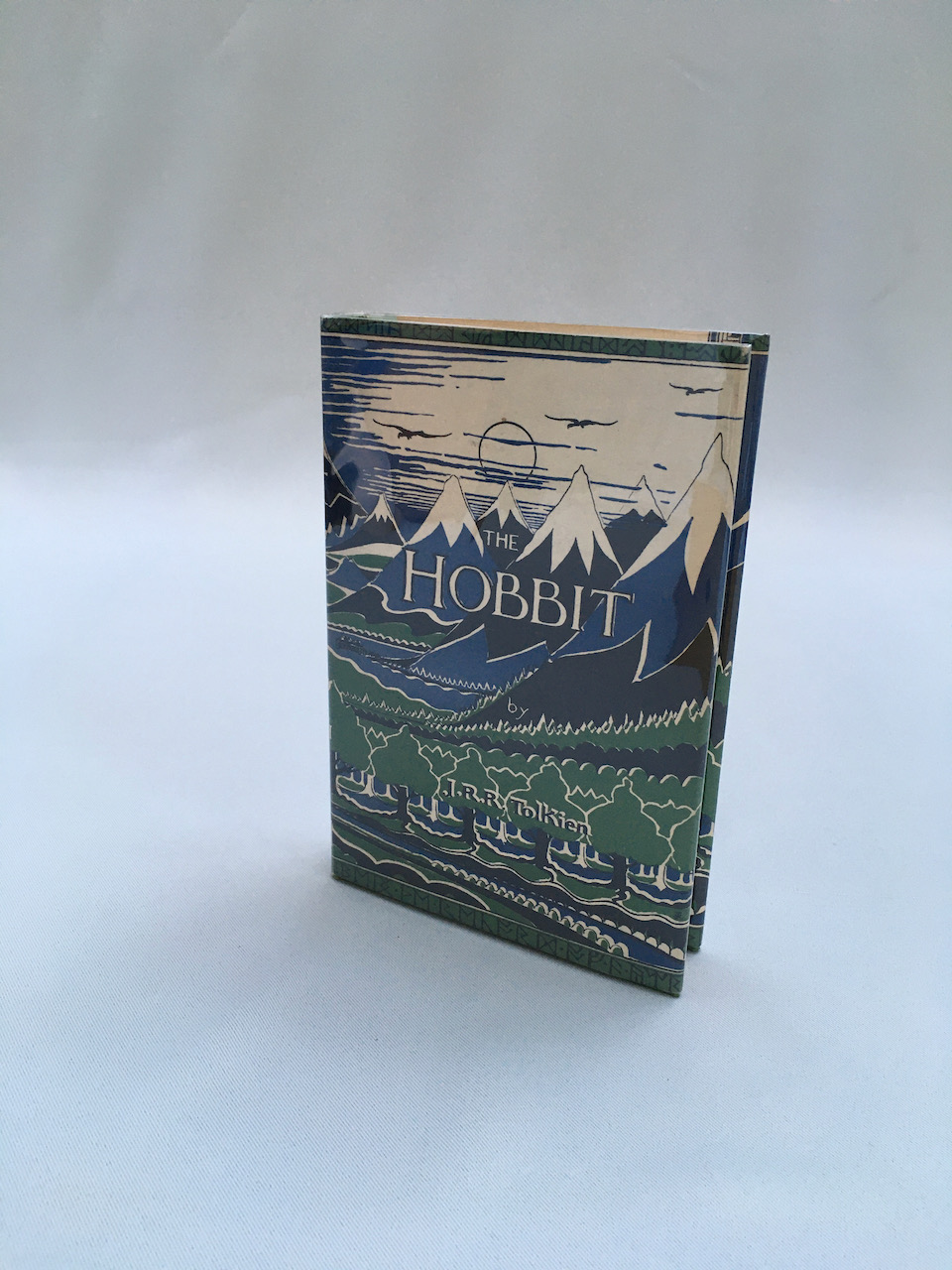
Tolkien’s most famous work began with a simple, spontaneous line scribbled on a student’s exam paper: “In a hole in the ground there lived a hobbit.” This line marked the beginning of The Hobbit, a story that Tolkien initially told to his children before it was published by George Allen & Unwin in 1937. Stanley Unwin, the head of the publishing firm, recognized the potential of the manuscript after his young son praised it, leading to its publication. The Hobbit became an instant success, receiving widespread acclaim from children and adults alike.
The story, though originally intended for children, hinted at a much deeper mythology. Tolkien’s creation of The Hobbit was informed by the rich legendarium he had been developing since World War I. This mythology, now known as The Silmarillion, included a history of Middle-earth that provided a much larger framework for his fiction. The book’s success led Unwin to ask Tolkien for a sequel, which eventually evolved into The Lord of the Rings. This transition from a children’s tale to a more complex epic marked a key turning point in Tolkien’s writing career .
The Lord of the Rings
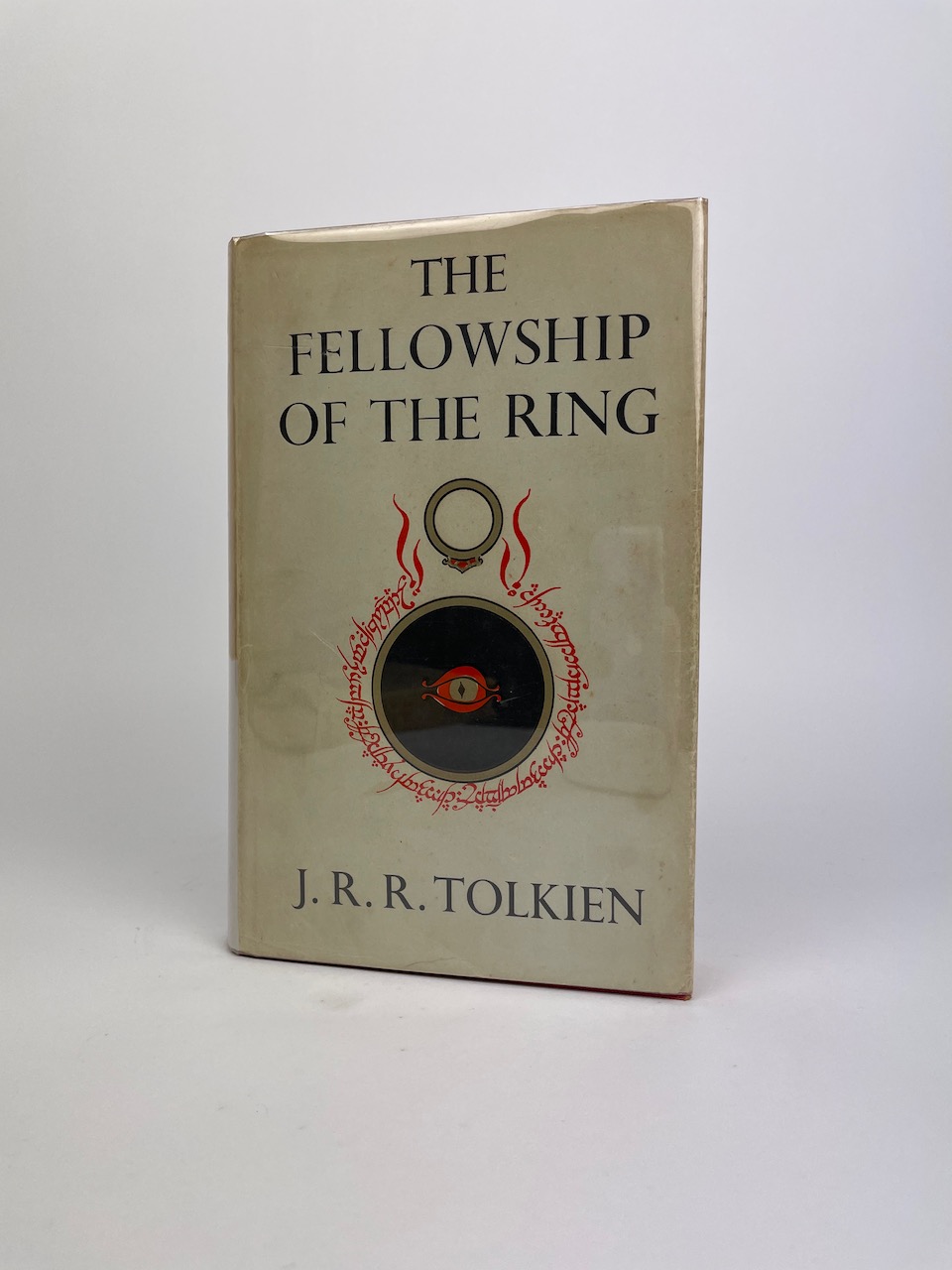
Stanley Unwin’s request for a sequel to The Hobbit led Tolkien to embark on what would become his magnum opus: The Lord of the Rings. Tolkien began work on the story in 1937, but the project quickly expanded into a multivolume epic. Drawing on the vast mythology he had created in The Silmarillion, Tolkien spent over a decade writing The Lord of the Rings, often leaving off for months at a time to resolve intricate details of language, lore, and history.
The book was published in three parts—The Fellowship of the Ring, The Two Towers, and The Return of the King—between 1954 and 1955. Although Tolkien was initially reluctant to split the story, the practical concerns of postwar paper shortages necessitated a multivolume release. While The Lord of the Rings received praise from many literary figures, including C.S. Lewis and W.H. Auden, some critics were less enthusiastic. Philip Toynbee famously derided the work, calling it “not literature” due to its reliance on fantasy tropes. Despite such criticism, Tolkien’s epic was embraced by the public.
The true explosion in popularity came with the 1965 paperback release. After a legal battle with Ace Books over an unauthorized edition, Ballantine Books released the official paperback version, making the trilogy widely accessible to new readers, particularly in the United States. The books quickly gained a devoted following among the counterculture of the 1960s. The Lord of the Rings has since sold over 150 million copies worldwide and has been translated into more than 70 languages.
Tolkien’s meticulous attention to detail—especially in his invented languages, cultures, and the deep moral struggles faced by his characters—gave the story a profound depth, far beyond a traditional fantasy narrative. Tolkien was also insistent that The Lord of the Rings was not an allegory, famously writing in the foreword, “I cordially dislike allegory in all its manifestations,” preferring readers to interpret the story on its own terms rather than through a political lens.
Tolkien’s Legacy
Tolkien’s work has often been described as contradictory in nature. On one hand, his stories are written in an almost archaic style, full of strange words and obscure historical details. On the other, his themes of environmentalism, friendship, and the clash between good and evil resonate deeply with modern readers. In this sense, The Lord of the Rings is both modern and antimodern, balancing timeless human concerns with the weight of history and myth.
Although Tolkien rejected allegorical readings of his work, readers and critics have often viewed The Lord of the Rings as a reflection of World War II or even the Cold War. Tolkien himself maintained that it was simply “a story to be taken on its own terms.” Yet, the themes of loss, self-sacrifice, and the struggle for power speak to universal human experiences, which is why his work continues to inspire and endure across generations .
Beyond literature, Tolkien’s legacy extends into numerous other realms of culture, from music to gaming and, most notably, film. The immense success of Peter Jackson’s film adaptations of The Lord of the Rings and The Hobbit have brought Tolkien’s work to a global audience. His writings have inspired countless authors, games, films, and virtual worlds, and continue to shape the fantasy genre.
Middle-earth after J.R.R. Tolkien
J.R.R. Tolkien passed away on September 2, 1973, but his legacy was far from complete. After his death, his son Christopher Tolkien took on the immense task of organizing and publishing his father’s unfinished works. The Silmarillion was published in 1977, though it had long been a part of Tolkien’s mythological vision. This was followed by Unfinished Tales (1980) and the 12-volume History of Middle-earth (1983–1996), which gave readers unprecedented insight into the evolution of Middle-earth and Tolkien’s creative process .
Christopher continued to curate and publish his father’s writings for decades, releasing The Children of Húrin (2007), Beren and Lúthien (2017), and The Fall of Gondolin (2018), completing the “Great Tales” of the First Age. His final major contribution was The Fall of Gondolin, published two years before his death in 2020.
After Christopher Tolkien’s passing, the task of preserving and expanding J.R.R. Tolkien’s legacy has been taken up by scholars such as Carl Hostetter, who edited The Nature of Middle-earth (2021). This volume explores Tolkien’s philosophical and metaphysical reflections on Middle-earth, shedding new light on his creative genius. Additionally, The Fall of Númenor (2022), edited by Brian Sibley, compiles Tolkien’s writings on the Second Age, offering a broader picture of the world he created . The recent publication of The Collected Poems of J.R.R. Tolkien (2023) has also brought together many of his lesser-known poetic works, further enriching the literary landscape Tolkien left behind .
References
• Carpenter, Humphrey. J.R.R. Tolkien: A Biography (2002).
• Hammond, Wayne G. & Christina Scull. J.R.R. Tolkien: Artist and Illustrator (1998).
• The Letters of J.R.R. Tolkien (Expanded Edition, 2023), edited by Humphrey Carpenter.
• Carpenter, Humphrey. The Inklings: C.S. Lewis, J.R.R. Tolkien, Charles Williams and their Friends (1997).
• Sibley, Brian, ed. The Fall of Númenor (2022).
• Hostetter, Carl, ed. The Nature of Middle-earth (2021).
• Garth, John. Tolkien and the Great War: The Threshold of Middle-earth (2003).
• Shippey, Tom. J.R.R. Tolkien: Author of the Century (2000).
Photo credits
• Portrait of J.R.R. Tolkien by Bill Potter: CAMERA PRESS / Bill Potter.