Tolkien Book Search Tips: How to Find Rare and Out-of-Print Books Online
Practical advice for searching, comparing and checking Tolkien books before you buy.
Searching for Tolkien books online can feel easy at first: type a title, browse the results, and hope the right copy appears. But serious collecting usually requires a little more patience. Rare Tolkien books, out-of-print editions, proofs, signed copies and unusual translations are often hidden behind incomplete descriptions, spelling mistakes, poor photographs, old listings or vague catalogue data.
This guide offers practical search tips for Tolkien collectors. It explains how to search by title, author, ISBN, publisher, edition, impression and even common misspellings, while also showing where online searches can become misleading.
Start Broad, Then Narrow Your Search
Begin with a broad search to see what is currently available, then slowly narrow your terms. Searching only for The Hobbit or The Lord of the Rings will usually produce too many results, but it can help you understand the general market. Once you see what appears, add extra details such as publisher, date, illustrator, binding, ISBN, edition or impression.
For example, instead of searching only for The Hobbit, try combinations such as:
The Hobbit Allen & Unwin
The Hobbit 1937
The Hobbit first edition
The Hobbit illustrated by Alan Lee
The Hobbit deluxe edition HarperCollins
The same method works for The Lord of the Rings, The Silmarillion, The History of Middle-earth and other Tolkien titles. Start with the title, then add the details that matter to the copy you want.
A frequently reprinted title — small differences in edition and printing can affect collectability.
Search for Misspellings and Variant Names
Not every seller describes Tolkien books correctly. Some listings contain spelling mistakes, missing initials or incomplete titles. These errors can be frustrating, but they can also help collectors find overlooked books.
Try searching for common mistakes and variations, including:
Tolkein instead of Tolkien
JRR Tolkien, J. R. R. Tolkien and J.R.R. Tolkien
Lord of the Ring instead of The Lord of the Rings
Silmarilion instead of The Silmarillion
Unwin, Allen Unwin and George Allen & Unwin
Misspelled listings are often poorly indexed and may receive fewer views. For a collector willing to search carefully, that can sometimes reveal interesting copies.
Search by ISBN, But Do Not Trust ISBN Alone
Searching by ISBN can be very useful, especially for modern Tolkien books, deluxe editions, boxed sets and illustrated editions. It can help you avoid unrelated results and quickly find copies of a specific edition.
However, ISBN searching has limits. An ISBN identifies a publication product, but sellers may attach the wrong ISBN to a listing, reuse catalogue data, or describe a later reprint as if it were the earlier edition. Reprints can also carry the same ISBN when the publisher has not treated them as a new edition. Always check the photographs, copyright page, number line, publisher, binding and date before relying on the ISBN alone.
For collectible Tolkien books, ISBN should be treated as a helpful clue, not final proof.
India paper editions — lightweight but highly collectible, often requiring precise identification when searching.
Search by Publisher, Illustrator and Format
Many Tolkien collectors search only by title, but some of the best results appear when you search by publisher, illustrator or format. This is especially useful for illustrated editions, deluxe editions, Folio Society editions, India paper editions and limited editions.
When buying collectible Tolkien books, condition matters. Try adding words that describe the kind of copy you want, but remember that sellers use condition terms differently.
Search terms such as fine, near fine, dust jacket, unclipped, signed, inscribed, sealed, slipcase, proof, advance reading copy or first impression can all help narrow results.
At the same time, do not accept these words without checking. A listing may say “fine” while the photographs show fading, foxing, bumped corners or a damaged jacket. Always compare the description with the images, and ask for more photographs when needed.
First impressions — often difficult to distinguish online without careful attention to details.
Beware of Old Listings and Outdated Websites
One of the most common frustrations when searching for rare Tolkien books online is finding a promising listing that is no longer available. Some old dealer catalogues, archived pages, image results and marketplace listings remain visible long after the book has been sold.
Before getting excited about a rare copy, check whether the page is current. Look for recent updates, active checkout options, seller contact details and signs that the site is still maintained. If the listing looks old, contact the seller before assuming the book is available.
Old listings can still be useful for research, especially when studying descriptions, prices and provenance, but they should not be treated as live offers unless confirmed.
Compare Several Sources Before Buying
Do not rely on one listing to judge rarity or value. Compare several sources whenever possible: specialist dealers, auction records, used-book platforms, collector forums and sold examples. Asking prices can be optimistic, outdated or simply wrong.
When comparing prices, make sure you are comparing like with like. A first impression in a dust jacket is not the same as a later impression without one. A signed limited edition is not the same as a standard trade edition. Condition, completeness, provenance and restoration all affect value.
You can also browse examples of rare Tolkien books sold online to understand how special copies have appeared on the market in the past.
Using ChatGPT and AI Search Tools for Tolkien Book Hunting
AI tools such as ChatGPT and other conversational search systems can be useful when researching Tolkien books. They can help you understand terminology, compare editions, build search queries, summarize seller descriptions and make a checklist of questions to ask before buying.
However, AI should not be treated as proof that a book is available, correctly described or fairly priced. Rare-book listings change quickly, and AI tools can sometimes summarize outdated pages, confuse editions, or miss important bibliographical details. For collectible Tolkien books, always verify the actual listing, photographs, seller information and edition details yourself.
A good way to use AI is to ask for better search phrases. For example: “Give me search terms for finding a first impression of The Silmarillion” or “What should I check before buying a signed Tolkien book online?” Then use those suggestions in real marketplace and dealer searches.
Ask the Seller the Right Questions
If a listing is unclear, ask before buying. A serious seller should be able to provide additional information and photographs, especially for rare or expensive Tolkien books.
Useful questions include:
Can you send photographs of the title page and copyright page?
Is the dust jacket original to the book?
Has the book or dust jacket been restored?
Is the price clipped?
Are all maps, plates, inserts or slipcases present?
Can you confirm the edition and impression?
For signed books, what is the provenance?
For signed material, compare the signature carefully and consult our guide to Tolkien signatures.
Use Want Lists for Scarce Tolkien Books
Some Tolkien books are too scarce to find by searching every few days. For these, a want list can be more effective. A want list tells dealers and collectors what you are looking for, including title, edition, condition, budget and any special requirements.
This is especially useful for signed books, proofs, deluxe editions, association copies, books from Tolkien’s personal library, early impressions in dust jackets and rare Tolkien ephemera.
You can read more about this approach on our want lists page, or browse current rare material in the Rare Tolkien treasures section.
When to Ask a Specialist
Searching is part of the pleasure of collecting, but there are moments when specialist advice can save time and money. If you are considering an expensive Tolkien book, a signed copy, a proof, a restored dust jacket, or a book with important provenance, it is wise to ask someone with experience before buying.
Small details can make a large difference. A supplied jacket, later impression, facsimile element, repaired page, wrong issue point or uncertain signature can change both value and desirability.
If you are looking for a specific Tolkien book, you are welcome to contact Tolkien Library. Many rare books are never listed for long, and some are sold privately to collectors with known want lists.
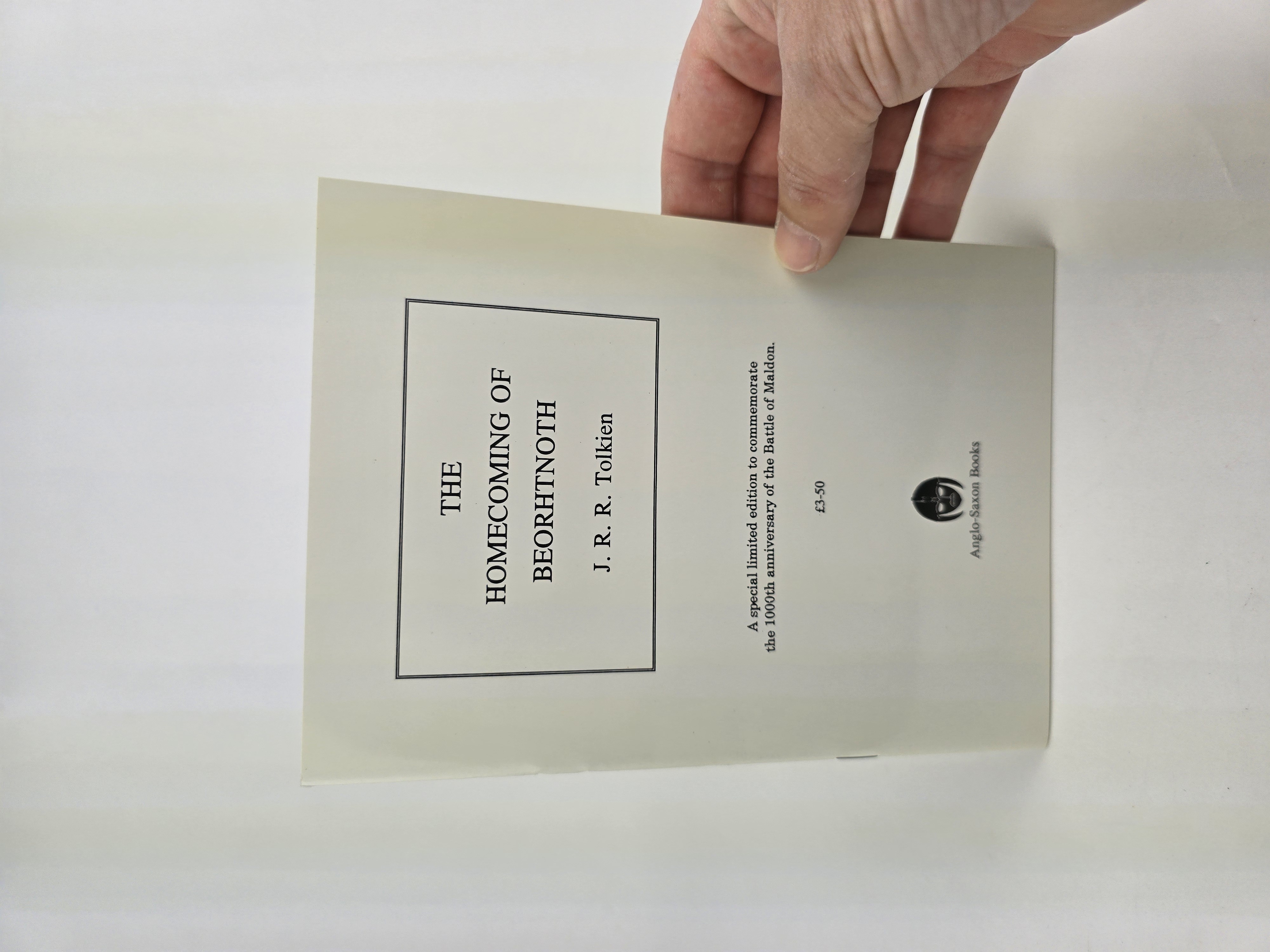
Early Tolkien publications — regularly appear with incomplete or unclear descriptions in online listings.
Search Patiently and Check Carefully
The best Tolkien book searches combine patience, curiosity and caution. Try different spellings, search by ISBN, publisher, illustrator and format, compare multiple sources, and never rely on a listing title alone.
Rare Tolkien books are not always easy to find, but careful searching often brings rewards. The more you learn about editions, impressions, condition and provenance, the better your chances of finding the right copy at the right time.