J.R.R. Tolkien & his works » Tolkien’s fiction and scholarly work » Books written by J.R.R. Tolkien » Unfinished Tales
Unfinished Tales
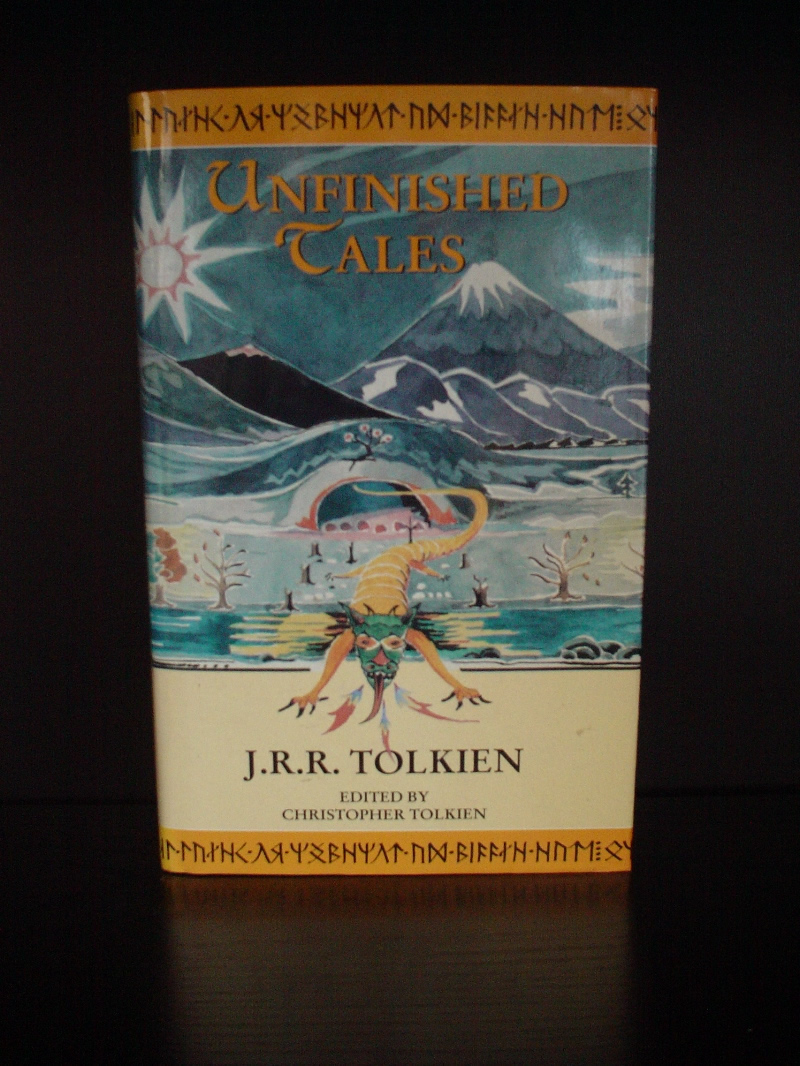
By J.R.R. Tolkien; edited by Christopher Tolkien (1980)
These narratives and essays extend the histories of Middle-earth across the First, Second and Third Ages. Christopher Tolkien presents his father’s unfinished writings with commentary, revealing more about Númenor, Gandalf, the Rings of Power and the events behind the familiar stories.
Description
'Unfinished Tales', as the title aptly suggests, is a collection of Tolkien's 'expanded' Middle Earth stories (mostly longer versions of tales from The Silmarillion, but there are plenty of revealing Lord of the Rings moments featuring old faves Gandalf, Elrond, The Nazgul, Balrogs et al) edited into a single volume by the authors son, Christopher Tolkien.
Unlike 'The Silmarillion' (which is universally recognised as a vital part of Tolkien's literary masterwork, but takes some effort to wade through the complexities of names, places, ages and references included in the earlier volume), 'Unfinished Tales' is surprisingly straightforward, by comparison; The style of writing is, for the most part, comparable to the tone of Lord of the Rings, including many (not to be missed) moments of classic Tolkien humour, some bitter-sweet observations on the human condition with regard to affairs of the heart and the spirit, and last but not least - lashings of swashbuckling adventure.
There is of course plenty of background detail and Tolkiens trademark descriptive passages read wonderfuly well.
Editions
Originally published by George Allen & Unwin on 2 October 1980 (number of copies not known, but the first three impressions together equalled 44.000 copies at £7.50) and by Houghton Mifflin on 18 November 1980 (80.000 copies at $15.00), also published by the Book-of-the-month Club. In June 1981 there was a reset book club edition, by the Science Fiction Book Club (number of copies unknown at $6.50). The first paperback edition appeared already one year later on 13 september 1982 by Unicorn / Unwin Paperbacks (15.000 copies at £2.95). 17 Days later there came an American trade paperback edition by Houghton Mifflin (30.000 copies at $8.25). ballantine Books also made an edition on September 1988 at $5.95. Since then there were many editions.
Review
J.R.R. Tolkien's tales of Middle-Earth weren't restricted just to fantasy epic "Lord of the Rings." His life's work was spread over hundreds of stories and invented legends - some were compiled into "The Silmarillion." But some were left over - yes, there were even more stories that didn't make the cut. These little odd bits make up "Unfinished Tales of Numenor and Middle-Earth." The stories are not as interconnected as the Silmarillion was, but they are a solid and enjoyable read.
This is most assuredly not a book for Tolkien neophytes and should only be read by people with at least a basic knowledge of the Middle Earth saga. Unfinished Tales is indeed "the one truly essential set of supplementary/outtake material", and Tolkien scholars are strongly advised to pick this up as soon as they finish reading The Silmarillion. For two reasons:
1. "The Silmarillion" is known to be a more difficult book- its presentational style renders it inaccessible to a lot of people. But if you manage to finish it you can reward yourself with Unfinished Tales, which deepens your enjoyment of "the Silmarillion" by providing more detailed (more gripping, more compulsively re-readable!) accounts of the same events, even though they are fragmentary and at-variance-with-other-writings.
The first section of the book begins with the expanded account of Tuor's early life and his mission to Gondolin which, for some, is the greatest of all Tolkien's obscure writings. But the piece that follows it, "Narn i hin Hurin" (tale of the children of Hurin), is certainly another candidate for the title - an extensive recounting of the disaster-ridden lives of Turin and Nienor. Even with a large section of the story (including the whole of Turin's sojourn in Nargothrond) missing, it winds up being the most emotionally draining thing Tolkien ever wrote.
The third section gives a more detailed background to the events at the end of the Third Age (i.e The Lord Of The Rings). There are accounts of "The Disaster of the Gladden Fields" and of the past tribulations of Rohan, and its special relationship with Gondor. There is Gandalf's perspective on the background to "The Quest of Erebor" (i.e The Hobbit), and, perhaps of most interest, Saruman's "Hunt for the Ring", or how lucky Frodo and Sam were even to get out of Hobbiton and begin their quest.
The fourth section contains almost all the existing data on the origin of the Palantiri, the histories of the Druedain (aka the woses) and the Istari (aka the wizards).
And what of the second section? Well, for one thing, it collects assorted writings on the subject of Galadriel and Celeborn - Tolkien's view of them continually shifting, a congruent history never quite emerging, even though he fills in a few gaps in the history of the Third Age in the process. The second section also fleshes out the history of the island of Numenor. Which brings us to...
2. Most of these posthumously published "archaelogical" volumes contain at least one "revelation" - a complete one-off in amongst all the spot-the-difference first and second drafts. And in this instance it's the the tale of "Aldarion and Erendis". It interrupts a capsule history of Numenor (a description of the island and a brief history of its ruling dynasty), shifting the focus from affairs of state to affairs of the heart, specifically the doomed romance between the sixth king of Numenor and a woman from the lower classes (so to speak: her shorter life-expectancy becomes an issue here). Where to begin describing this great tale? Well, if I may step out of character and oversimplify, Aldarion and Erendis began like Tristan and Isolde and ended like Charles and Diana. Which means two things become apparent here: Tolkien's flair for romance and his deficient social politics. In the end, whether Tolkien intended this or not, it works as a parable against arranged marriages.
A place to begin: “The Quest of Erebor”. I would read this with the first chapter of The Hobbit open beside it. At Bag End, Bilbo has to make sense of the wizard’s choice while the visitors eat his food and doubt his usefulness. In Unfinished Tales, Gandalf looks back on that choice after the War of the Ring. Christopher places the conversation in Minas Tirith, after Aragorn’s coronation, with Frodo recording what Gandalf tells the company.
Pause where Gandalf asks after Bilbo and hears from Holman, the gardener, that he has gone away again. Bilbo has mentioned the Elves’ New Year and cannot say when he will be back. This is a useful passage to set beside the respectable householder at the beginning of The Hobbit. Gandalf remembers the child who asked questions about the world outside the Shire. He also sees a practical possibility: a quiet-footed hobbit might approach a dragon where heavy-booted Dwarves could not. The choice grows out of what he knows about Bilbo and what he needs to do about Smaug.
Then turn to the appendix, “Note on the texts of ‘The Quest of Erebor’”. Christopher distinguishes an early manuscript, A, a typescript made from it, B, and a more tightly constructed manuscript, C, which he regards as later. C supplies the main account; extracts from B follow the editorial note. In those extracts, Gandalf recalls the hobbits’ courage and care for one another during the Long Winter. He wants them to understand more of the dangers beyond the Shire, and begins with one person. Read that passage beside the account already given. It adds another reason for sending Bilbo out of his front door.
The appendix is worth reading as part of the story. Keep Christopher’s explanation beside the extracts so that you can see which text you are in. His labels let us follow Tolkien trying different ways of telling the account. Read both versions before trying to fit every detail into a single history.
Reading references: Unfinished Tales, Part Three, III, “The Quest of Erebor”, and its appendix, “Note on the texts” and “Extracts from the earlier version”; The Hobbit, chapter I, “An Unexpected Party”.
Summary: "Unfinished Tales" is a fill-in-the-gaps sort of book, and Tolkien's storytelling genius still shines through in this disjointed collection of essays, bits and pieces. For those hungering for more Middle-Earth. Unfinished, but definitely not Unnecessary.
Book details
Author: J.R.R. Tolkien
Edition note: edited by Christopher Tolkien (1980)
Find a copy
Find Unfinished Tales on AbeBooks
Find Unfinished Tales on Amazon.co.uk
Find Unfinished Tales on Amazon.com
These are affiliate links. Tolkien Library may earn a commission from qualifying purchases, at no extra cost to you. The cover shown is an earlier edition; check the seller’s edition and ISBN before ordering.