Mr. Bliss
Written and illustrated by J.R.R. Tolkien (1982)
Mr. Bliss buys a yellow motor car with red wheels, and his first drive soon becomes a series of comic disasters. Created for Tolkien’s children, this story pairs his handwritten text with colourful drawings of eccentric characters, unexpected passengers and the remarkable girabbit.
Description
Professor J.R.R. Tolkien invented and illustrated this book of Mr. Bliss’ adventures for his own children when they were young. The story is reproduced here exactly as he created it – hand-written with lots of detailed and uproarious coloured pictures.
It is a complete and highly imaginative tale of eccentricity. Mr. Bliss, a man notable for his immensely tall hats and for the girabbit in his garden, takes the whimsical decision to buy a motor car. But his first drive to visit friends quickly becomes a catalogue of disasters. Some of these could be blamed on Mr. Bliss’ style of driving, but even he could not anticipate being hi-jacked by three bears.
What happened next the reader, whether young or old, will want to discover for himself. Thankfully all ended well, and even the yellow motor car with red wheels (to which Mr. Bliss had taken an understandable and great dislike) came in useful at the end.
According to Mrs. Michael Tolkien, the story was inspired by young Christopher Tolkien's toy car, not, as stated by Humphrey Carpenter in Tolkien biography, by Tolkien's own vehicular mishaps with his first car, purchased in 1932. The bears were based on toy bears owned by Tolkien's sons. Jared C. Lobdell assigned the writing of the story to 1928-32 (1). But Christina Scull and Wayne Hammond give a suggestion that the tale might be conceived a bit later, because of the use of the name Gamgee Gaffer in Mr. Bliss, a name Tolkien and his kids created for a curious local character during a summer holiday in Cornwall (2).
The narrative binds the story and illustrations tightly together, as the text often comments directly on the pictures. Finally it will be for sale again and we can all enjoy the tale once again!
Editions
The manuscript lay in a drawer until 1957, when he sold it (as well as the original manuscripts of The Lord of the Rings, The Hobbit, and Farmer Giles of Ham) to Marquette University for 1,250 pounds.
By late 1964 the story came to the attention of Clyde S. Kilby, who had met Tolkien that year and had been corresponding with him about Mr. Bliss and proposed to get it published. Tolkien had started to dislike the story and saw it as a private joke, and decided it would be best for his reputation to have it published posthumously (3).
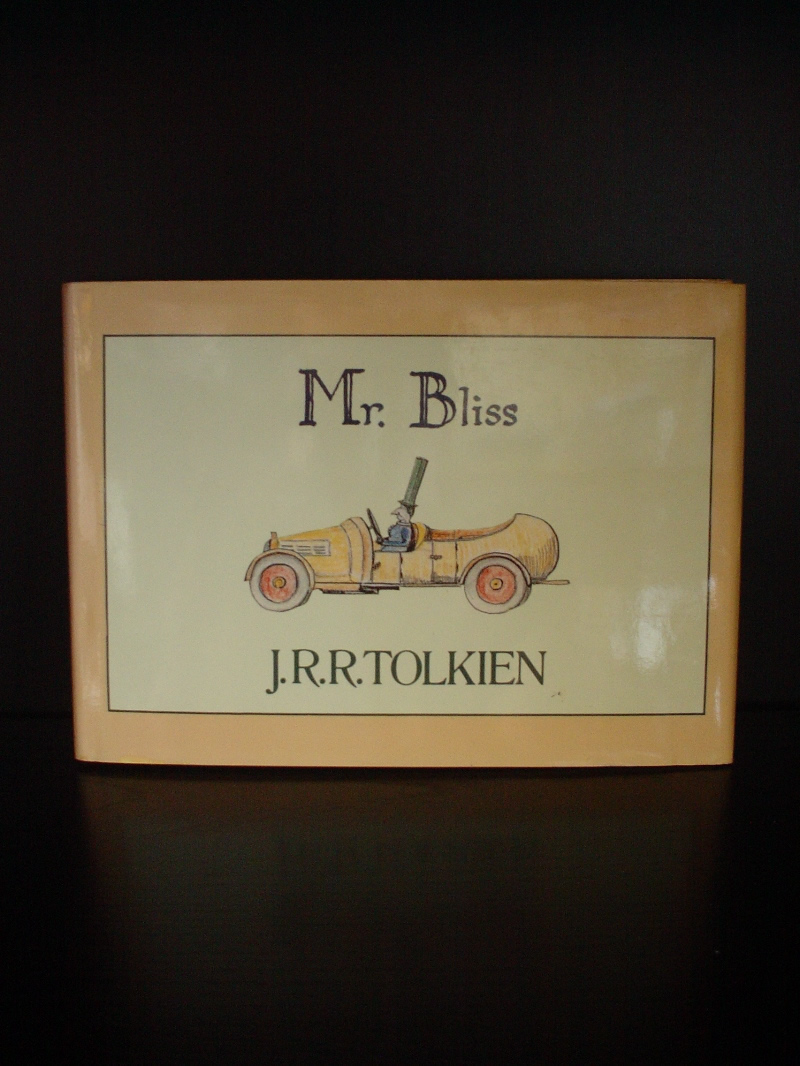
And so it happened, 9 years after Tolkien's death, Mr. Bliss was finally published in 1982, with Tolkien's difficult-to-read handwritten story and illustrations on one page, and a typeset transcription on the facing page. The story was reproduced exactly as Tolkien created it - handwritten with lots of detailed and uproarious colourpictures.
First printings are now rather hard to find in perfect condition, luckily later printings can be found more easily.
Estimate: 108 pages
Publisher: HarperCollins
Publication Date: 22 September 1994 (UK)
Language: English
Format: 189x246 mm
ISBN-10: 0261102532
ISBN-13: 978-0261102538
Estimate: 104 pages
Publisher: HarperCollins
Publication Date: September 1982 (UK)
Language: English
Format: 189x246 mm
ISBN-10: 0048232157
ISBN-13: 978-0048232151
The Revised Edition of Mr. Bliss
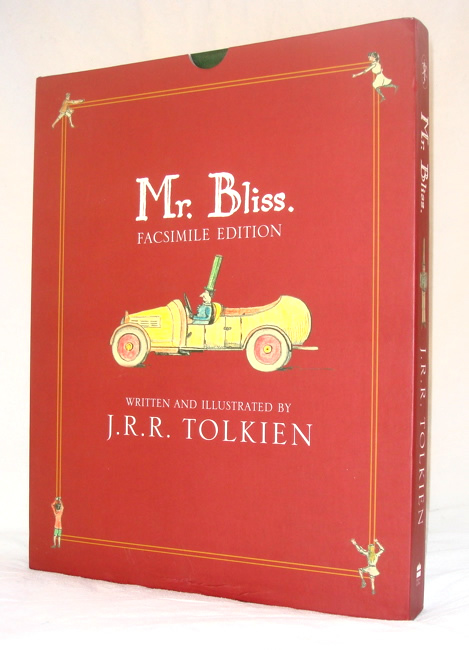
Originally published in 1982, the book has been out of print since the 1990s. This slipcased hardcover edition marks the 25th anniversary of publication.
It has now a completely different look as the first edition, and has been completely redesigned to make it the definitive edition, ideal for collectors and newcomers to the story.
The printing and binding company Imago in China has done a brilliant job! The improvement can best be appreciated if you lay the revised edition next to the first edition; you immediatly get the feeling the revised edition can easily be called the 'deluxe' edition of Mr. Bliss.
During the Children of Hurin Release Party we had the opportunity to talk with Matt Blessing, the Head of the Department of Special Collections and University Archives at Marquette University in Milwaukee (who hold the manuscripts for four books: The Hobbit, LOTR, Mr. Bliss (the original hand drawn book), and Farmer Giles of Ham). I knew there was being prepared a new edition of Mr. Bliss and so I asked: We will see a new printing of Mr.Bliss this year and the illustrations are made from new scans... how was this realized?
"Yours truly made the scans on a Epson scanner...huge TIFFs. The clarity is impressive, if I say so myself. The new edition will really show off Tolkien's skills."
In the revised version the pages can be seen as facsimiles put on a green background; while in the old version the scans are reproduced within a very thick black line. The new way of presenting gives us the idea that the real pages have been glued on top of a green background, you can even see the damages to the edges of the manuscript, which is very wonderful.
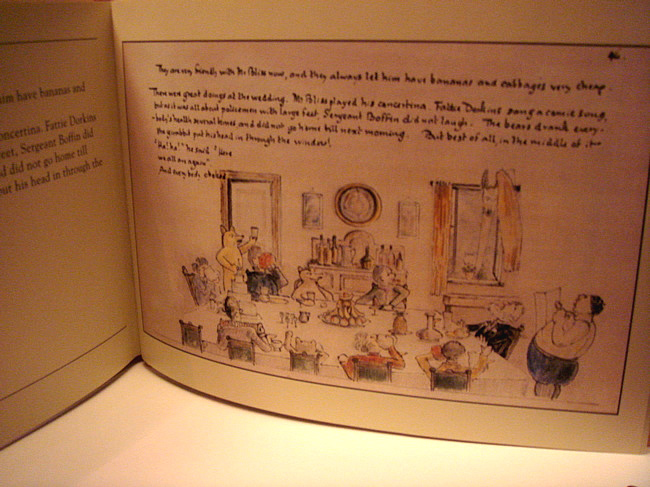
Also the lettertype is a tiny bit larger, which is much better in a children book.
So, whe you will buy this new revised edition you will see that each page of Tolkien’s original 1930s manuscipt is reproduced in facsimile, with his own coloured illustrations and distinctive handwriting. Facing each page is the story, fully typeset for ease of reading, especially for younger readers. All pictures have been newly scanned from the archive manuscripts to give the best possible reproduction. We have to thank Matt Blessing for making these wondeful scans; the result is abslutely stunning.
Estimate: 112 pages
Publisher: HarperCollins
Publication Date: Revised edition - 15 Oktober 2007 (UK)
Language: English
Format: 189x246 mm
ISBN-10: 0007255330
ISBN-13: 978-0007255337
The Trade Edition of Mr. Bliss
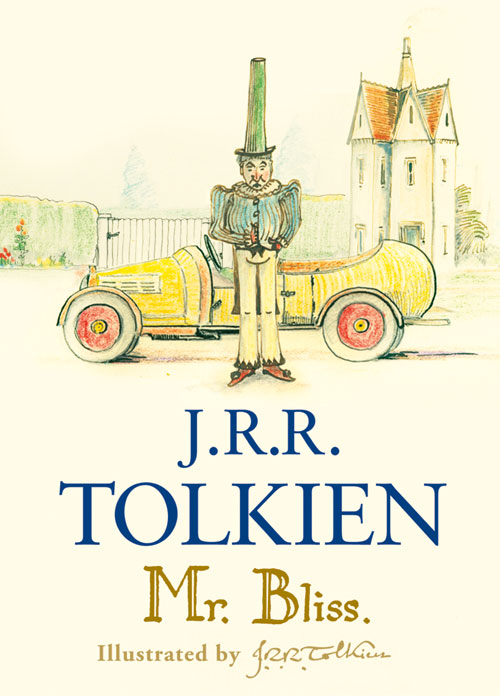
Estimate: 192 pages
Publisher: HarperCollins
Publication Date: trade edition - 29 September 2011
Language: English
Format: 14.2 x 20.7 cm
ISBN-10: 000743619X
ISBN-13: 978-0007436194
Review
Mr. Bliss is a very eccentric, very British children's story written by Professor Tolkien for his own children.
Imagine a children's picture book illustrated by Tolkien, creator of The Lord of the Rings and The Hobbit, involving a man with tall hats and a bad driving record, and a very British feel, and you have MR BLISS.
It largely shows his distrust turned hatred of things mechanical that destroy the environment. But make no mistake: this is no propaganda track written to slam pollution, it is first and foremost a story for children, his children. It is basically a humourous exploration, beautifully illustrated, of what could go wrong with an unexperienced driver (namely Mr Bliss).
Easily the strangest character is a Girabbit, a type of animal invention that must be particular to British society, or even more localised to Tolkien's imagination, for I have never encountered him anywhere else; it has that feel of Britain, so it would not surprise me if it was British and not Tolkien's own invention.
However, all of his children's fiction, save The Hobbit, has the particular feel. It is a rabbit with a very long neck (hence the name Girabbit, combining Giraffe and Rabbit).
The story is that a man named Mr Bliss goes and buys a Motor Car. Thru the course of the story, he has several interactions with his neighbours and three bears. His acquisition of a motor car is quite disastrous, and momentarily devastating, and in the end Mr Bliss finds the motor-car unnecessarily troublesome, and has "taken a great dislike to it".
This attitude he expressed in the unpublished TALES AND SONGS OF BIMBLE BAY. According to Carpenter, his official biographer, Tolkien took a "charge `em and they scatter" method of driving, and was much more daring than was skillful. But here, it is expressed humourously. If any moral can be drawn from it, it is that motor cars are trouble. Afterward, Tolkien takes this attitude and develops it in a much more sophisticated and mature form in The Lord of the Rings.
But this story delights in being for children, and one notable word play is two characters, of which Mr Bliss had an accident with involving his motor car, go into business together, and they call it after their names, which is Day and Knight. It is this type of word play that makes Tolkien's children's fiction notable.
An interesting note about this story is that it was to be originally published back in 1937 or 1938, when The Hobbit had been accepted for publication. On the strength of it, Tolkien had submitted several other shorter works, including Farmer Giles, Roverandom, this, and the Quenta Silmarillion proper. Because of the illustrations it proved uneconomical to publish, and was set aside for years and years, a fate Roverandom would also share (sadly).
His illustrations are nicely done, showing Tolkien's skill as a (physically) visionary and not just a literary artist. His style is definitely all his own. Overall, a nicely down story for Children, written by the master of fantasy, J. R. R. Tolkien.
Footnotes:
(1) Jared, C. Lobdell - 'MR. Bliss: Notes on the Manuscript ans Story', Selections from the Marquette J.R.R. Tolkien Collection (Milwaukee: Marquette Universaty Librayry, 1987), pp. [5-10].
(2) Christina Scull & Wayne, G. Hammond - 'The J.R.R. Tolkien Companion and Guide' (HarperCollinsPublishers, 2006), Vol. II, pp. [590-592].
(3) Wayne, G. Hammond & Douglas, A. Anderson - 'J.R.R. Tolkien A Descriptive Bibliography' (Oak Knoll Press & The Britisch Library, 2002), pp. [239-242].
Book details
Author: J.R.R. Tolkien
Edition note: (1982)
Find a copy
Find Mr. Bliss on AbeBooks
Find Mr. Bliss on Amazon.co.uk
Find Mr. Bliss on Amazon.com
These are affiliate links. Tolkien Library may earn a commission from qualifying purchases, at no extra cost to you. The cover shown is an earlier edition; check the seller’s edition and ISBN before ordering.


