Songs for the Philologists by J.R.R. Tolkien
The rarest Tolkien book to appear on eBay?
During the early years of online Tolkien collecting, remarkable books still surfaced publicly on eBay before the market fully matured. Specialist booksellers were only beginning to embrace online marketplaces and some extraordinary Tolkien material briefly appeared in public auctions before disappearing once more into private collections.
This remarkable copy of Songs for the Philologists appeared on eBay UK in November 2005, offered by specialist dealer ADC Books from the Cotswolds. Even then the booklet was already considered one of the rarest and most elusive Tolkien publications ever produced.
Privately printed in 1936 at University College London, Songs for the Philologists was never commercially published and only a very small number of copies are believed to survive today. The work originated from the famous “Viking Club” founded by J.R.R. Tolkien and E.V. Gordon during Tolkien’s Leeds years, where students gathered to discuss Old Norse literature, languages, songs, and — quite famously — drink beer.
Because most copies were reportedly destroyed in a fire after the printing exercise, surviving examples have become legendary among Tolkien collectors. For many collectors, this is not merely one of the rarest Tolkien books — but perhaps the rarest of all.
Historical auction details
Platform: eBay UK
Object number: 8350387696
Auction start date: 5 November 2005
Auction end date: 15 November 2005
Starting price: £8,500
Bids: 0 bids
Seller: adcbooks
Location: Cotswolds, United Kingdom
Status: Archived historical listing
Even in 2005, an asking price of £8,500 represented a major Tolkien rarity. Today, surviving copies are so rarely offered publicly that establishing a true market value has become increasingly difficult.
Original archived eBay description (2005)
Songs for the Philologists
ADC Books are pleased to offer:
Songs for the Philologists
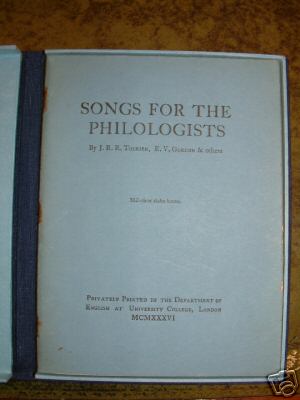
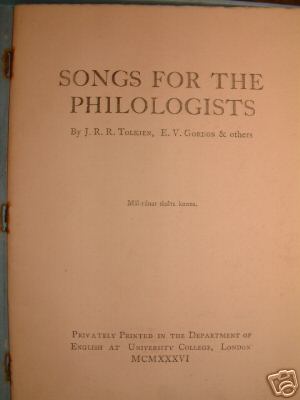
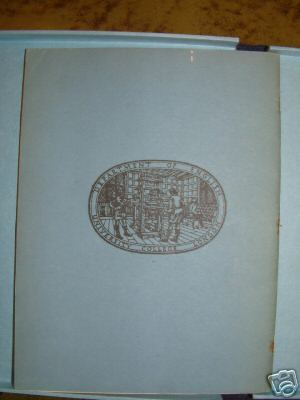
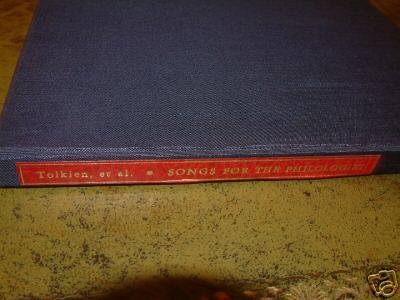
Privately printed in the Department of English at University College London MCMXXXVI. 1936. Printed pale blue wrappers, saddle-stitched, in near fine condition with no internal inscriptions, marks or faults. Staples rusting as to be expected. Housed in a matching clam-shell case and also protected from handeling. This booklet was printed on the Colleges private press as an exercise by Dr A H Smith (formerly a student at Leeds) to a group of his students. Dr Smith realised he had not asked permission of either Tolkien or Gordon so the books were not distributed but stored in a room at the press in Gower Street. Most of the copies were destroyed in a fire that destroyed part of the building in which the press was housed. Evidently some survived. It is thought that only 14 exist. This is the most rare of all Tolkien books. Please ask for images or further information. Conforms to Hammond and Anderson B15 pages 293-294. Details of the 30 Songs available upon request.
Many thanks to Tolkienlibrary.com for this detailed article.
Songs for the Philologists
When asking a Tolkien collector which book is the most precious book in his collection, it will probably be a perfect first edition of the Lord of the Rings, a signed book, like a Silmarillion signed by Christopher Tolkien, or a nice reading copy of an old the Hobbit. Yet when asked what would be the most rare Tolkien book out there, the answer would probably be "The Songs for the Philologists". Everyone has seen the book before in Tolkien bibliographies all over the internet. Yet what is it all about, and why does it come up for sale for $15000 (if it comes up for sale at all), and how rare is it really.
Songs for the Philologists is perhaps the rarest and most difficult to find Tolkien related book. In Leeds J.R.R.Tolkien and E.V.Gordon founded a "Viking Club" for undergraduates devoted mainly to reading Old Norse sagas and drinking beer. It was for this club that Tolkien and Gordon originally wrote their Songs for the Philologists, a set of duplicated typescripts, containing a mixture of traditional songs and original verses translated into Old English, Old Norse and Gothic to fit traditional English tunes.
In 1935 or 1936 Dr A.H. Smith of University College London, former student at Leeds, gave a copy of one of the typescripts to a group of students to print at their private press as a printing exercise. There for we can assume there were not many copies printed originally. He later realized that he had not asked for permission from Tolkien or Gordon, so the completed booklets were not distributed. Most of the copies were destroyed in a fire at the college where the press and copies of the book were stored, but evidently some copies survived, perhaps retained by the students who printed them. The number that survive is not known, but is very small, perhaps as few as 14.
Inside Songs for the Philologists
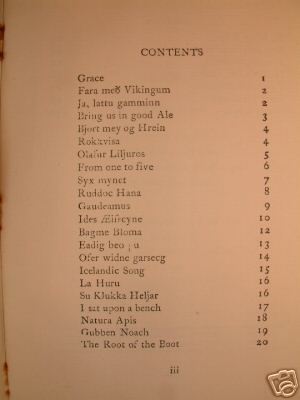
There were 30 songs in the collection, J.R.R.Tolkien contributed 13. Further details can be found here.
'From One to Five'. To be sung to the tune of ‘Three Wise Men of Gotham’.
'Syx Mynet'. In Old English, to be sung to the tune of 'I Love Sixpence'.
'Ruddoc Hana'. In Old English, to be sung to the tune of 'Who Killed Cock Robin'.
'Ides ælfscýne'. In Old English, to be sung to the tune of ‘Daddy Neptune’. Reprinted, together with a Modern English translation ('Elf-fair Lady') in The Road to Middle-earth.
'Bagm? Blom?'. In Gothic, to be sung to the tune of ‘O Lazy Sheep!’. Reprinted, together with a Modern English translation ('Flower of the Trees') in The Road to Middle-earth.
'éadig Béo þu!'. In Old English, to be sung to the tune of ‘Twinkle, Twinkle, Little Star’. Reprinted, together with a Modern English translation ('Good Luck to You') in The Road to Middle-earth.
'Ofer Wídne Gársecg'. In Old English, to be sung to the tune of ‘The Mermaid’. Reprinted, together with a Modern English translation ('Across the Broad Ocean') in The Road to Middle-earth.
'La Húru'. To be sung to the tune of ‘O’ Reilly’.
'I Sat upon a Bench'. To be sung to the tune of ‘The Carrion Crow’.
'Natura Apis: Morali Ricardi Eremite'. Also to be sung to the tune of ‘O’Reilly’.
'The Root of the Boot'. To be sung to the tune of ‘The Fox Went Out’. Reprinted in Anderson’s Annotated Hobbit, and in a revised form in The Return of the Shadow. Also reprinted in The Tolkien Papers: Mankato Studies in English. Later revised and printed in The Lord of the Rings and The Adventures of Tom Bombadil as 'The Stone Troll'.
'Frenchmen Froth'. To be sung to the tune of ‘The Vicar of Bray’.
'Lit' and Lang''. To be sung to the tune of ‘Polly Put the Kettle On’.
The above is a summary of that given in Hammond’s Descriptive Bibliography. For full details see pages 293 & 294.
Identification of the Book
Songs for the philologists is privately printed in the Department of English at University College, London, in 1936.
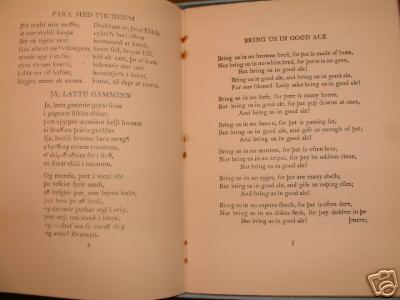
It is the first and only edition, 8vo (214mm.), pp. iv, 30, [2]; orig. printed pale blue wrappers, saddle-stitched; with staples. The text is in both English and Anglo-Saxon and is printed in both Roman and Anglo-Saxon types. On the verso of the title: "Printed by G. Tillotson, A.H. Smith, B. Pattison and other members of the English Department, University College, London." SUNY-Buffalo and Oxford University only in OCLC.
This is a stunning copy and for the tolkien collector.
Please ask any questions.
Collectors condition.

The story behind Songs for the Philologists
Songs for the Philologists originated during Tolkien’s years at Leeds University, where Tolkien and fellow scholar E.V. Gordon founded a “Viking Club” for students interested in Old Norse literature, medieval languages, songs, and drinking traditions.
The collection contained a mixture of humorous songs, linguistic exercises, translations, and original compositions written in Old English, Gothic, and other ancient languages. Many were intended to be sung to familiar English tunes.
Tolkien contributed thirteen songs to the collection, including pieces such as The Root of the Boot, which later evolved into “The Stone Troll” in The Adventures of Tom Bombadil and The Lord of the Rings.
The surviving booklet therefore offers an extraordinary glimpse into Tolkien’s academic world before Middle-earth fully emerged. It preserves Tolkien not only as author, but as philologist, teacher, humorist, and lover of languages.
Why this book became legendary among Tolkien collectors
Unlike Tolkien’s commercially published books, Songs for the Philologists was never intended for public distribution. The booklet existed almost accidentally.
According to the historical account repeated in bibliographies and collector references, Dr A.H. Smith arranged for students at University College London to print the work privately as a printing exercise around 1935 or 1936. Realising afterwards that permission had not been obtained from Tolkien or Gordon, the completed copies were never distributed officially.
Most copies were later destroyed in a fire affecting the building where the press and stored copies were located. Historical accounts often repeated an estimate of fourteen surviving copies. Ongoing copy-census research has identified additional examples, so fourteen should not be treated as a confirmed present-day total.
Because of this remarkable survival story, the booklet achieved almost mythical status within Tolkien collecting circles long before many collectors had ever even seen a genuine copy offered publicly.
A fascinating moment in the Tolkien market
This archived listing captures an extraordinary moment in Tolkien collecting history. In 2005, a surviving copy of Songs for the Philologists could still appear publicly on eBay with a visible asking price and open bidding format.
Today, many comparable treasures disappear quietly into major private collections through specialist dealers or private negotiations long before they ever reach public marketplaces.
The listing is also interesting because ADC Books directly referenced Tolkien Library within the original auction description, reflecting the growing importance of online Tolkien collecting communities during the early years of the modern Tolkien market.
Historical pages such as this preserve not only remarkable books, but the history of Tolkien collecting itself.