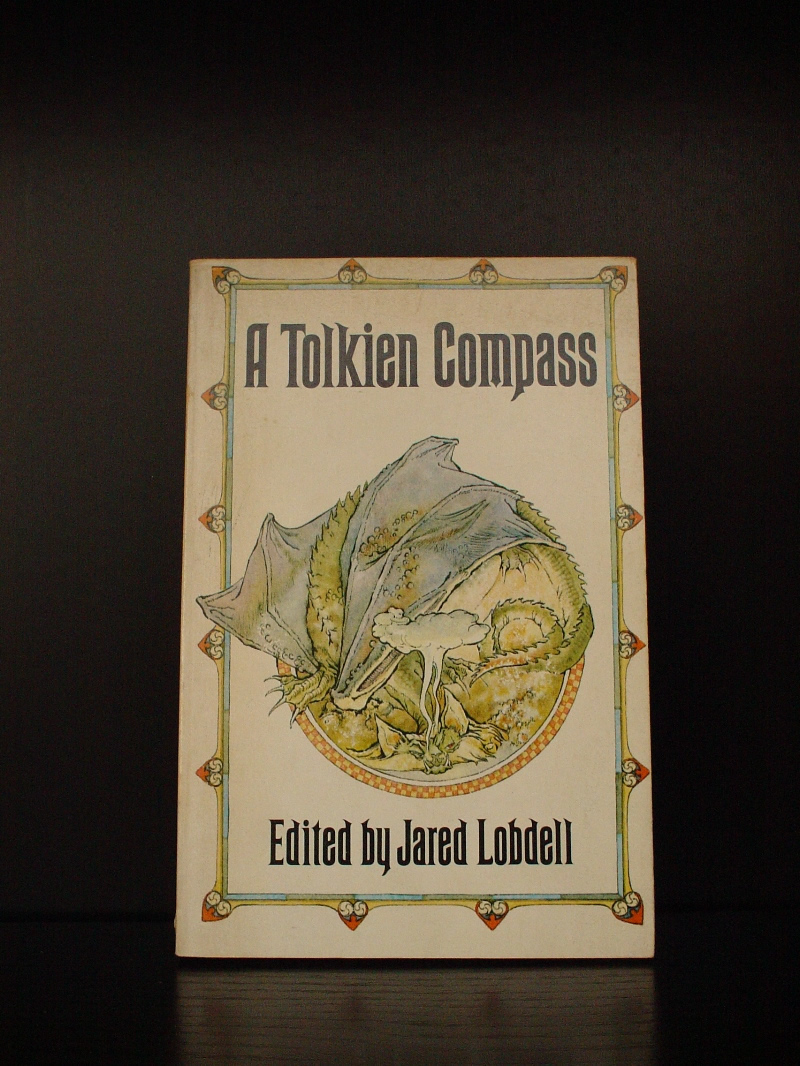
A Tolkien Compass
Edited by Jared Lobdell (1975)
A Tolkien Compass is one of the earliest collections of scholarly essays on the works of J.R.R. Tolkien, offering fresh perspectives on The Lord of the Rings, The Hobbit, and Tolkien’s mythology. It is notable for being a valuable resource for both new and veteran Tolkien enthusiasts, featuring insights into key themes, characters, and the complex moral and philosophical landscape of Middle-earth.
Book Overview
Originally published in 1975, A Tolkien Compass includes 11 chapters contributed by various scholars who delve into multiple aspects of Tolkien’s writing. The essays cover a broad spectrum, from character studies to moral and psychological interpretations. One of the standout features of the original edition was a special chapter written by Tolkien himself, titled “Guide to the Names in The Lord of the Rings,” which provided detailed explanations of the etymology and meaning behind the names in Middle-earth. Unfortunately, this key chapter was omitted in later editions, making the original a sought-after collector’s item.
Key Themes and Essays
The essays in A Tolkien Compass explore a variety of intriguing questions:
• Gollum’s Character Transformation: Bonniejean Christensen’s essay delves into the duality of Gollum’s character in The Hobbit and The Lord of the Rings, especially analyzing the two versions of the Riddles in the Dark chapter.
• Psychological Journey of Bilbo Baggins: Dorothy Matthews analyzes Bilbo’s growth throughout The Hobbit, though some criticism has been directed at her overuse of psychological jargon in describing a hobbit’s mental state.
• Fairy-Tale Morality: Walter Scheps examines the ethical framework in The Lord of the Rings, comparing Tolkien’s use of traditional fairy-tale morals to his complex portrayal of good and evil.
• Power and Corruption in Middle-earth: Agnes Perkins and Helen Hill explore the dynamics of power in Middle-earth, focusing on the corrupting influence of the One Ring.
• The Scouring of the Shire and Fascism: Robert Plank draws parallels between the regime set up by Saruman in the Shire and real-world fascism, offering a socio-political lens through which to view Tolkien’s work.
These essays provide valuable insight into Tolkien’s characters, themes, and narrative techniques, encouraging readers to look beyond the surface of his stories and consider the deeper moral and psychological underpinnings.
Editions and Publishing History
First Edition (1975): A Tolkien Compass was first published by Open Court Publishing and quickly became an important academic resource for Tolkien scholars and fans alike. The first edition featured Tolkien’s Guide to the Names in The Lord of the Rings, a glossary and pronunciation guide written by Tolkien himself, which was a major draw for readers.
Reprints: Over the years, A Tolkien Compass was reprinted several times. However, later editions, including the reissue in the early 2000s, notably removed Tolkien’s own chapter, which was a significant disappointment to many collectors and scholars. The reprint editions consist solely of the essays, without Tolkien’s guide.
Critical Reception and Reviews
Upon its initial release, A Tolkien Compass was met with enthusiasm by both casual fans and Tolkien scholars. The essays, while accessible to a broad audience, were praised for offering substantive analyses without being overly academic or obscure. Bonniejean Christensen’s essay on Gollum and Walter Scheps’s exploration of morality in Tolkien’s work were especially well-received. However, Dorothy Matthews’ psychoanalytic approach to Bilbo was met with mixed reactions; some found the heavy use of technical jargon off-putting, though the insight into Bilbo’s personal growth was still appreciated.
The removal of Tolkien’s Guide to the Names in later editions was a major point of contention among readers. As one reviewer pointed out, the absence of this unique chapter made the reissue “incomplete,” since Tolkien’s insights into the linguistic origins of his character names were seen as a significant bonus in understanding his world-building process.
In-Depth Opinion
For readers interested in exploring Middle-earth through various critical lenses, A Tolkien Compass remains a valuable resource. It showcases early academic efforts to interpret Tolkien’s world beyond just the narrative, delving into moral, psychological, and sociopolitical aspects of his work. The essays are largely readable for both academics and general fans, though the removal of Tolkien’s Guide to the Names in later editions diminishes the uniqueness of the reissue.
Despite this, the collection is highly recommended for those who wish to see Tolkien’s world analyzed from multiple perspectives. The book provides a multifaceted look at Middle-earth, with its contributors offering interpretations that remain relevant to modern readers and scholars alike.
Why You Should Read It
If you are a fan of The Lord of the Rings or The Hobbit, and you want to explore Tolkien’s world from a more analytical standpoint, A Tolkien Compass offers a broad yet insightful look at his work. Each essay provides a fresh perspective on Tolkien’s characters, narrative techniques, and philosophical themes. It is also a significant part of Tolkien scholarship history, as one of the earliest collections dedicated to studying his literature.
A Tolkien Compass
Edited by Jared Lobdell
1st Edition 1975
Open Court
La Salle
ISBN 087548316X
Hardback in dustwrapper
Cover illustration by Lester Abrams
Hammond Page Ref.: pp.326-327
Buy from Abebooks.
Buy from Amazon.co.uk.
Buy from Amazon.com.