
The amazing art of bookbinding - The Silmarillion
Bookbinding, at its finest, transforms a text into a true work of art—and few works invite such craftsmanship as The Silmarillion. From richly tooled leather covers to intricate, hand-crafted details inspired by Tolkien’s mythology, these unique bindings reveal how deeply artists and collectors engage with Middle-earth. This selection highlights some of the most striking interpretations, where storytelling and artistry meet in remarkable and often one-of-a-kind creations.
It has been a nice four days, looking at some of the most beautiful copies of The Hobbit, The Lord of the Rings, and the incredible book art by Philip Smith. We have seen bindings by some of the most renowned companies, we have seen craftsmanship and true book art.
Today we will look at The Silmarillion. It was very difficult to find fine rebindings of The Silmarillion—in fact, it seems not many have been made. I have tried to locate copies bound by the better binderies, but could not find many examples. So Tolkien lovers, do you own a copy, know of one, or create fine bindings yourself? Please do send information and pictures, and I will happily add them here.
The Silmarillion — Philip Smith rebinding
This extraordinary binding of The Silmarillion was created by bookbinder and artist Philip Smith (with the note inside the cover: “Philip Smith Designed 1978–79, Completed 1980”). The front of the book consists of two flaps of sculpted dark morocco with inlaid stones, covering a hand-painted triptych inspired by Tolkien’s mythology.
.jpg)
At the back of the book we see the face of Morgoth with his crown and two Silmarils, while the spine carries Tolkien and The Silmarillion in gold and palladium. The book is housed in a matching slipcase.
This is without doubt one of the most impressive bindings ever created for The Silmarillion. The copy is well documented through its appearance at Christie’s (Paris, 11 December 2008, sold for €13,750), confirming its importance not only as a work of art, but also as a key piece within the history of Tolkien bookbinding.
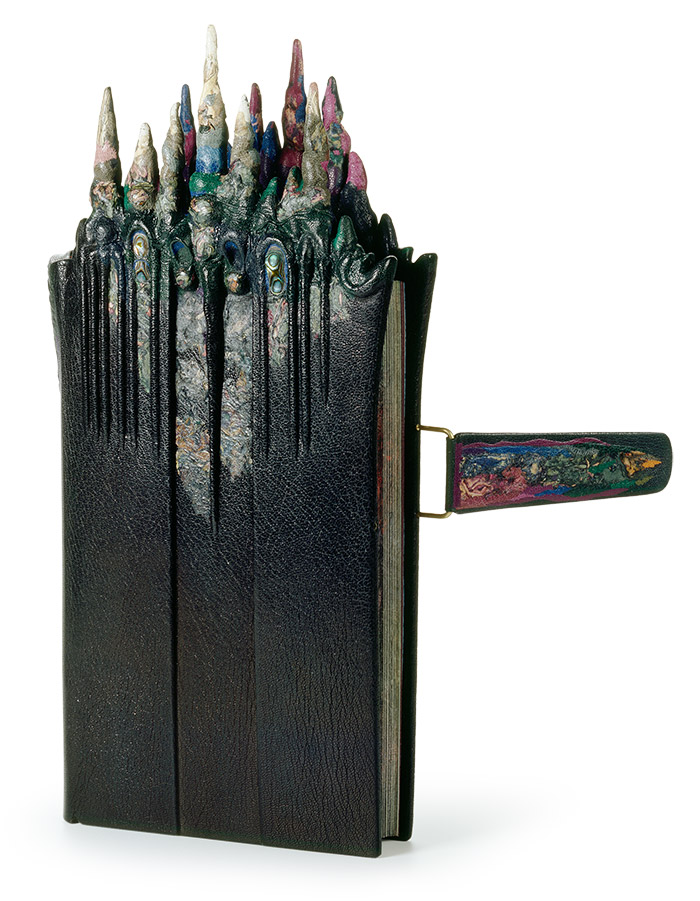
Although this example is the best known, Philip Smith created several different bindings of The Silmarillion, each completely unique. Another striking version (shown above - documented through Philip Smith’s own archive) demonstrates his more architectural approach, with vertical sculptural forms rising from the boards—suggesting towers, rock formations, or even the hidden light of the Silmarils within the world itself. It remains in a private English collection.

A further example is now held in the Lilly Library at Indiana University (USA), where it forms part of their collection of fine bindings and book arts. This copy has been digitised and can even be explored in 3D, offering a rare opportunity to study Smith’s work in detail—from its internal structure to the layered surfaces and materials he employed.
Featuring dramatic upper edges of rising, almost crystalline forms and, in some cases, functional sculptural clasps, these bindings capture both the darkness and the splendour of Tolkien’s mythology. The tactile quality of the leather, combined with painted and modelled elements, makes them objects that move far beyond traditional bookbinding.
Together, these examples firmly establish Philip Smith as one of the most innovative book artists of his time. His Silmarillion bindings remain among the most ambitious ever created—each one a singular attempt to give physical form to Tolkien’s creation myths.
The Silmarillion — Modern red morocco for Asprey and Garrard .jpg)
In addition to Smith’s work, another remarkable rebound copy of The Silmarillion appeared at Christie’s, created by a different hand yet equally impressive in its craftsmanship. While more restrained in form, it demonstrates the high level of artistry that modern binders continue to bring to Tolkien’s works, combining traditional techniques with a deep appreciation for the text.
Together, these examples show that The Silmarillion continues to inspire some of the most ambitious and imaginative bookbinding of our time. Whether through the bold, sculptural vision of Philip Smith or the refined elegance of other master binders, each copy offers a new way to experience Tolkien’s creation.
The Silmarillion — Benjamin Harff Edel-Silmarillion
Ok, technically this copy is not a rebinding and in fact is not even an officially published printing of The Silmarillion. But it is one of the most beautiful copies of The Silmarillion I have ever seen. You can read the interview with Benjamin Harff, who created this Silmarillion as exam at the Academy of Fine Arts.
All the initials, the calligraphic pages and illumination are drawn and painted by hand. The pages were bound in a leather goatskin cover to give the book an amazing finish.
It is amazing how one person spent almost one and a half years writing, decorating and illuminating The Silmarillion. The result is truly stunning.

The Silmarillion — David Miller rebinding
The following first edition of The Silmarillion was bound by a highly talented American bookbinder and was commissioned by David Miller, a specialised Tolkien book dealer.
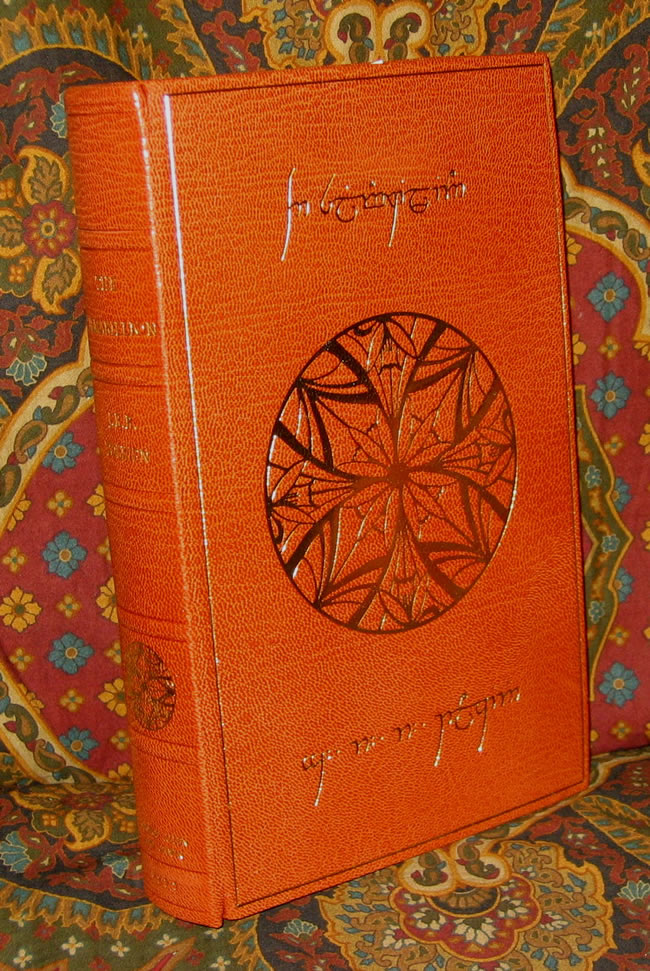
This copy has been newly rebound in full Terra Cotta morocco leather. All edges of the textblock have been trimmed and gilded. Custom marbled paper by Joan Ajala of Australia was used for the endpapers to ensure the highest quality possible.
The design features Tengwar title and author gilt-stamped to the front boards, with a large gilt-stamped image of the heraldic device Tolkien designed to represent Lúthien Tinúviel.
The rear boards carry the JRRT monogram, with a single gilt rule to all edges and turn-ins. The raised bands on the spine include smaller versions of the heraldic device, while The Silmarillion, J.R.R. Tolkien, George Allen & Unwin, and 1977 are all stamped in gold in the compartments.
Similar versions in different types of leather have been made, and all look fantastic. It must be a true pleasure to read a work like The Silmarillion in such a fine binding.
The Silmarillion — Super Deluxe Edition by George Allen & Unwin 1982
The last copy I want to show is a fine example of the very hard-to-find Super Deluxe Collector’s Edition of The Silmarillion. It is a limited edition of 1,000 copies, published by George Allen & Unwin in 1982. The first 100 copies of this edition were signed by Christopher Tolkien.
The first 1,000 copies of the 1977 first edition were set aside and rebound in red leather in 1982. It is rumoured that not all of these were actually bound and issued. Based on how rarely copies appear today, this rumour may well be true.
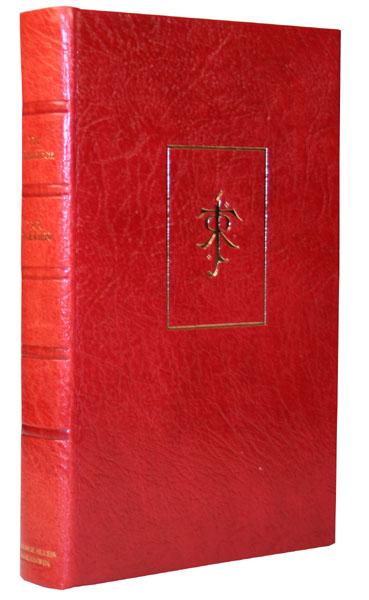
This edition features the original publisher’s full red leather binding, with cloth and a matching red leather slipcase, as issued. The book includes a red silk ribbon marker, raised bands, and gilt-stamped title, author, and publisher on the spine.
The front boards feature the JRRT monogram in a single ruled box, while the limitation plate on the first free endpaper gives the individual copy number.
With this beautiful example, I would like to conclude this four-day journey through some of the most remarkable copies of The Lord of the Rings, The Hobbit, and The Silmarillion. I truly hope this article will continue to grow over time, as more collectors share images and information about other unique bindings. I hope it has been both interesting and inspiring to Tolkien fans everywhere.
Related Articles

In a quiet gallery in Oslo, two weathered pine planks carry one of the North’s greatest legends. Their carved figures—dragon, hero, sword, smith—once framed the doorway of Hylestad Stave Church in Setesdal. Around the year 1200, a Norwegian carver told the tale of Sigurd Fáfnisbani in wood long before it was written in Icelandic vellum.
Centuries later, J.R.R. Tolkien drew from the same deep tradition. His lectures, his retellings, and the design of his books reveal how this medieval doorframe echoed through his imagination. The journey from Hylestad to Tolkien is one of craft, storytelling, and the northern imagination carried forward across eight hundred years.

How do two minds from opposite sides of belief — one a devout Catholic mythmaker, the other a Norwegian pessimist — arrive at the same understanding of consciousness as a wound?
In this long-form reflection, written from the northern coast of Norway, Pieter Collier explores the unexpected dialogue between J. R. R. Tolkien and Peter Wessel Zapffe.
Through the fading light of The Silmarillion, he traces how Tolkien’s Elves, Fëanor’s fire, and the “long defeat” echo Zapffe’s philosophy of tragic awareness — and how both writers, in their own ways, transform despair into endurance, and endurance into art.

After years of quiet work behind the scenes, Tolkien collector Pieter Collier shares the story behind his move to Norway — a journey of illness, silence, and renewal. From his new home in Trollbergvika overlooking the Skagerrak, he reflects on why he withdrew, why he returns, and what lies ahead for the Tolkien Library and the lifelong work that began more than three decades ago.