The amazing art of bookbinding - The Hobbit
This article explores the remarkable art of fine bookbinding through a selection of exceptional editions of The Hobbit. From richly jeweled designs to elegant, understated craftsmanship, these bindings transform Tolkien’s classic into true works of art. Drawing on both traditional techniques and imaginative interpretations of Tolkien’s own illustrations, each example highlights the unique ways binders bring Middle-earth to life beyond the printed page.
Yesterday we looked at a variety of beautiful rebound copies of The Lord of the Rings, and the day before we saw the fabulous fine art bindings by Philip Smith. Today we will look at some splendid fine bindings of The Hobbit. Some have a very lavish binding, others a perfectly classical one, and some can only be described as true pieces of book art. While at the Tolkien Library there are often some very beautiful rebound copies of The Hobbit available, today we will focus on some of the most remarkable rebindings ever made, together with a few other unique artistic bindings that simply deserve to be shown. I am certain any book lover will enjoy these fine bindings of The Hobbit, especially as many use Tolkien’s own drawings and designs as decoration. This can range from full reproductions of Tolkien’s illustrations to motifs inspired by his hand. I am obliged to begin with perhaps the most impressive copy of The Hobbit ever produced: a lavish binding by Sangorski and Sutcliffe Zaehnsdorf.
The most lavish binding of The Hobbit by Sangorski and Sutcliffe Zaehnsdorf
Probably the most lavish binding of The Hobbit ever made is this important association copy, inscribed by the author on the front flyleaf with “To Stella Mills, from her old friend, J.R.R. Tolkien.” Stella Mills was a student of E.V. Gordon and J.R.R. Tolkien at Leeds, and she later edited and translated The Saga of Hrolf Kraki, an Icelandic heroic saga published by Oxford University Press in 1933.
In The Road to Middle-earth by Tom Shippey we read that the character of Beorn in Tolkien’s The Hobbit was inspired by Bödvarr Bjarki from the Hrolf Kraki saga. Her translation was in fact dedicated to J.R.R. Tolkien. Ms. Mills remained a close friend of the Tolkien family throughout her life. This particular copy was a gift from Tolkien to Stella Mills and bears a fine early autograph inscription.
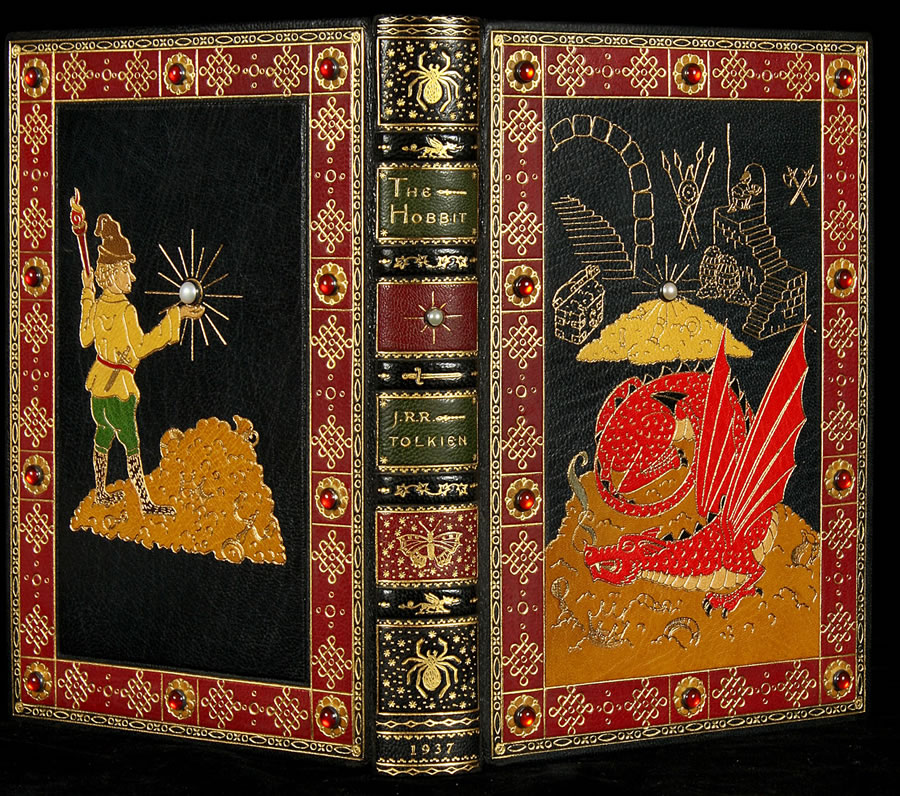
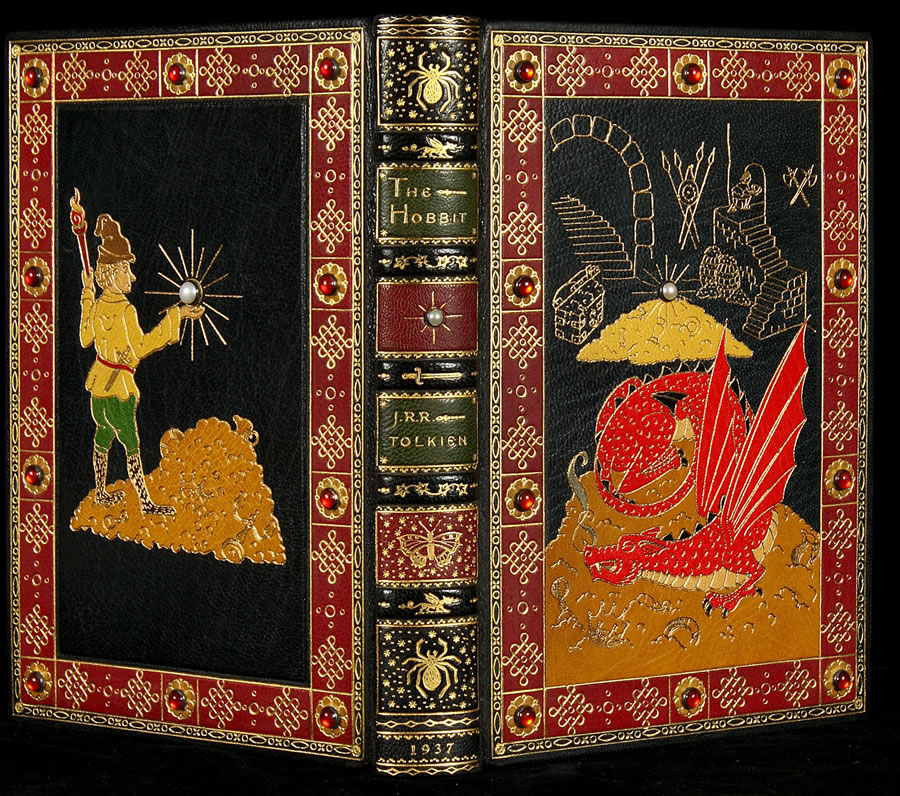
This copy of The Hobbit is a fine example of how far one can go to make a book stand out and show its value at a single glance. The book is finely bound by Sangorski and Sutcliffe Zaehnsdorf in full black morocco, a bindery celebrated for sumptuous and highly decorative work.
This binding was executed after 1990 by Zaehnsdorf, renowned for fine bindings since 1842 and later associated with Sangorski & Sutcliffe.
It is gilt tooled and decorated with onlays in many colours, with the front and rear covers each jewelled with ten red stones within the borders and a single white jewel within the central designs. A third white jewel adorns the spine.
The silk moiré endleaves, gilt-rolled board edges, and fully gilt page edges make this Hobbit a truly stunning copy.
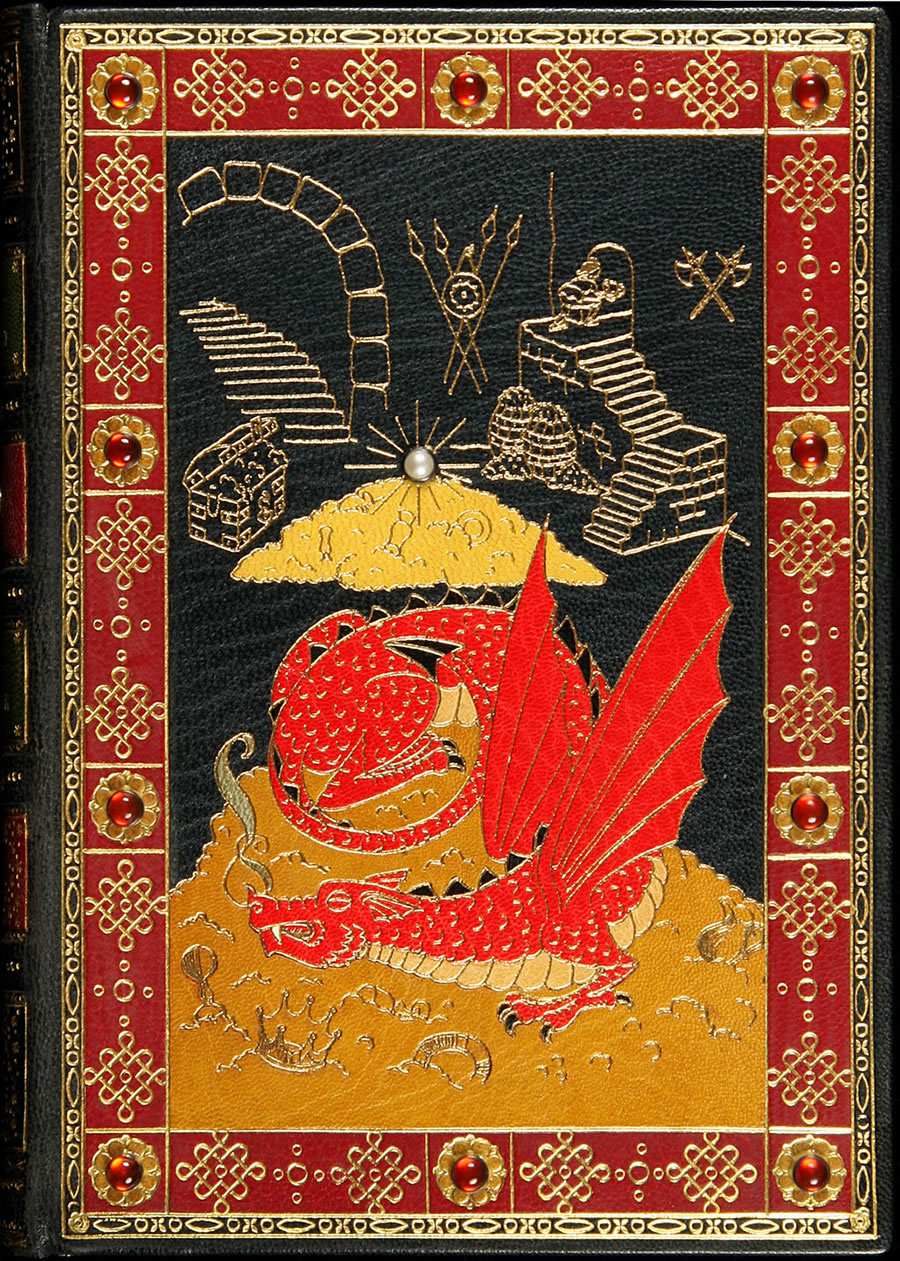

On the front cover, within a cave-fortress drawn in gilt, a sinuous red dragon guards piles of treasure surmounted by a radiant pearl, presumably representing the Arkenstone of Thráin.
On the rear cover, the hobbit approaches the treasure, holding a torch and a pearl. Both covers have onlaid maroon and green borders decorated with Celtic interlace and gilt lozenges, with ten red jewels set within small yellow floral onlays. The spine, in six compartments separated by gilt-tooled raised bands, carries four coloured labels adorned with butterfly, spider, sword, and dragon tooling in gilt, together with a further white jewel.


The full morocco front and rear doublures are bordered, titled, and accented in gilt, created in an intricate mosaic of many coloured onlaid morocco depicting two imaginary landscapes from the book, Rivendell and Mirkwood.
The binder made a small mistake and wrote “Riverdell”, but it still resembles Tolkien’s own interpretation of the valley very well.
The volume is housed in a velvet-lined, book-style drop-back case of full morocco, titled in gilt on the spine.
This first edition, first printing has changed hands a number of times and was recently estimated by PBA Galleries at between USD 60,000 and USD 90,000.
The The Hobbit binding with superb onlays by The Chelsea Bindery
The first of Tolkien’s works of fiction to be published, The Hobbit began as an amusement for the Tolkien children and reached print rather unexpectedly, after a typescript had been shown to the publisher by one of Tolkien’s former pupils.
Allen & Unwin originally planned to illustrate the book only with the endpaper maps, but Tolkien’s first sketches so charmed the publisher’s staff that they decided to include them without increasing the price, despite the extra cost. Encouraged by this, Tolkien supplied a second batch of illustrations.
The publisher accepted all of them, giving the first edition ten black-and-white illustrations in addition to the two endpaper maps. The first colour plates only appeared six months later in the first American edition of The Hobbit.
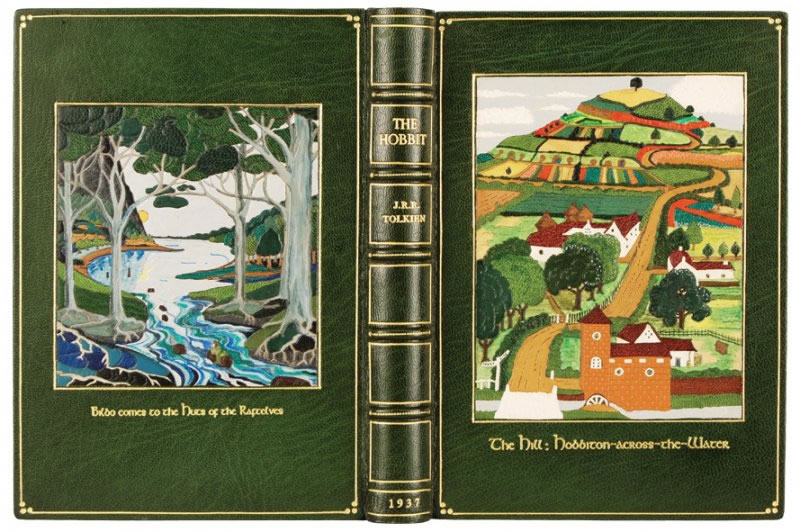
To honour Tolkien’s own artwork, The Chelsea Bindery used these illustrations to decorate this first impression of The Hobbit with superb onlays. On the front board, the onlay echoes the scene of the frontispiece, Hobbiton-across-the-Water. On the rear board, Bilbo floats in his barrel towards the huts of the Raft-elves. Together these two splendid onlays make this copy one of the most beautiful rebindings ever made.
Finely bound by The Chelsea Bindery in full green morocco, this first impression of The Hobbit also has gilt titles and decoration on the spine, raised bands, a single gilt rule to the boards, elaborate onlays to both covers, twin gilt rules to the turn-ins, black coated endpapers, and all edges gilt.
This remarkable piece of art was offered by Peter Harrington at GBP 15,000.

Bayntun-Riviere bindings of The Hobbit
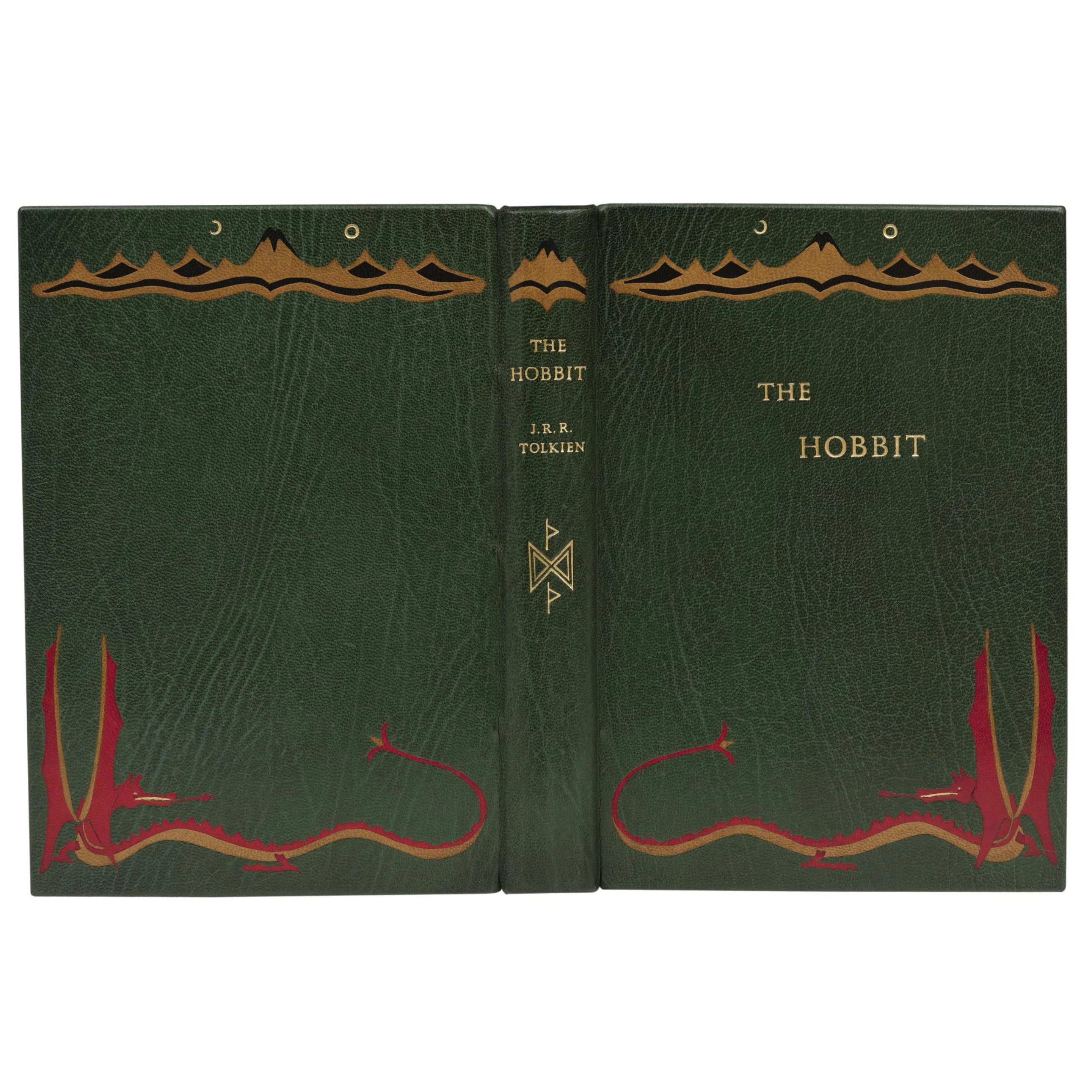
Bayntun-Rivière, long known for superior bindings, rebound several copies of The Hobbit, including this fine example of the 1937 UK first impression.
This copy is particularly interesting from a bibliographical perspective, being a first edition, first issue, with the well-known “Dodgeson” correction made in ink on the inside lower flap of the dust-jacket. It retains the ten original illustrations and pictorial endpapers by Tolkien, together with the publisher’s advertisements at the end.
The binding itself is executed in sumptuous full green morocco and signed by Bayntun-Rivière, with morocco onlays on both the upper and lower covers depicting Smaug in red and brown, set against stylised mountain forms. The spine continues this theme with additional onlays, together with gilt lettering and runic decoration.
The upper cover of the original binding has been trimmed and bound in at the rear. Marbled endpapers, gilt edges, sewn head- and tailbands, and a full green morocco folding box duplicating the spine of the volume in gilt and onlays complete the work.
This copy was sold at Sotheby’s in December 2007 for GBP 11,875.
Bayntun bindings of The Hobbit
In more recent years, Bayntun—continuing the long tradition of fine English bookbinding—has produced a number of elegant and highly refined bindings of The Hobbit. While less overtly decorative than some earlier artistic interpretations, these bindings stand out for their craftsmanship, balance, and respect for Tolkien’s original design language.
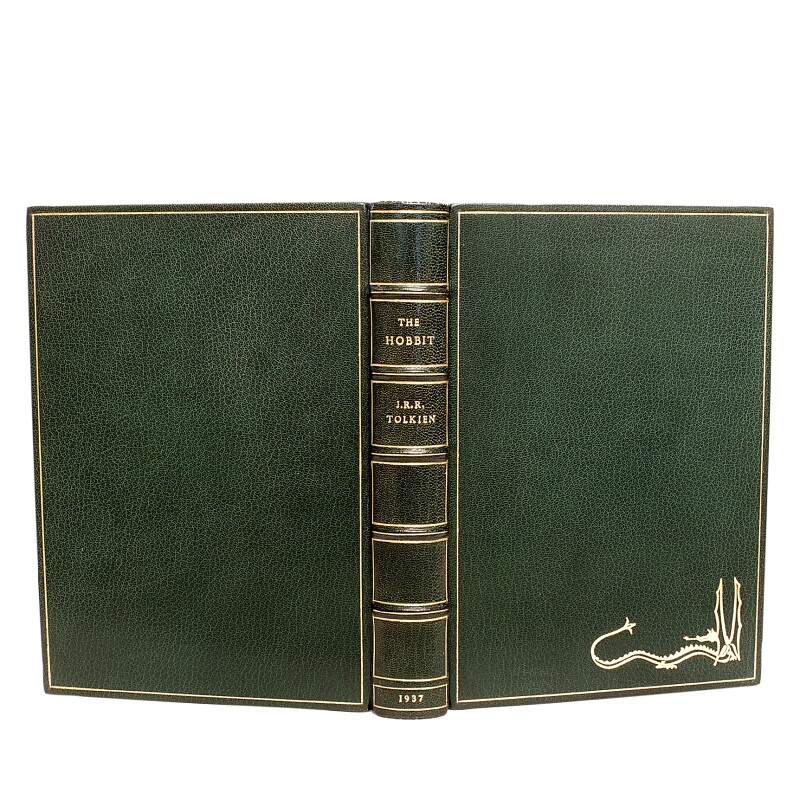
This particular example is a first edition, second impression of The Hobbit, notable as the first issue to include colour plates. It has been finely rebound in full dark green morocco, with a ribbed spine decorated in gilt and covers ruled with simple gilt lines. A small but effective gilt depiction of Smaug appears on the lower corner of the front cover, adding a subtle narrative element without overwhelming the design.
The binding is completed with gilt dentelles, all edges gilt, and marbled endpapers. Importantly, the original cloth covers and spine have been preserved and bound in at the rear, together with the original map endpapers—ensuring that the bibliographical integrity of the book is maintained alongside the new binding.
This copy was offered by Sotheby’s for USD 12,000, reflecting continued demand for high-quality, classically executed bindings of Tolkien’s most beloved work.
The Hobbit — Asprey & Garrard scarlet morocco binding (1938)
This striking example of The Hobbit presents the first American edition (1938), notable as the first appearance of Tolkien’s illustrations in colour. The edition itself is already important from a bibliographical perspective, with the earliest issue identifiable by the bowing hobbit on the title-page, as seen here.
The volume has been rebound in sumptuous full scarlet morocco by Asprey & Garrard, with a richly decorative scheme that draws directly on Tolkien’s own artwork. The upper cover features a scene inspired by The Hill: Hobbiton across the Water, while the lower cover depicts The Misty Mountains looking West from the Eyrie towards Goblin Gate, both rendered in finely executed coloured morocco onlays.
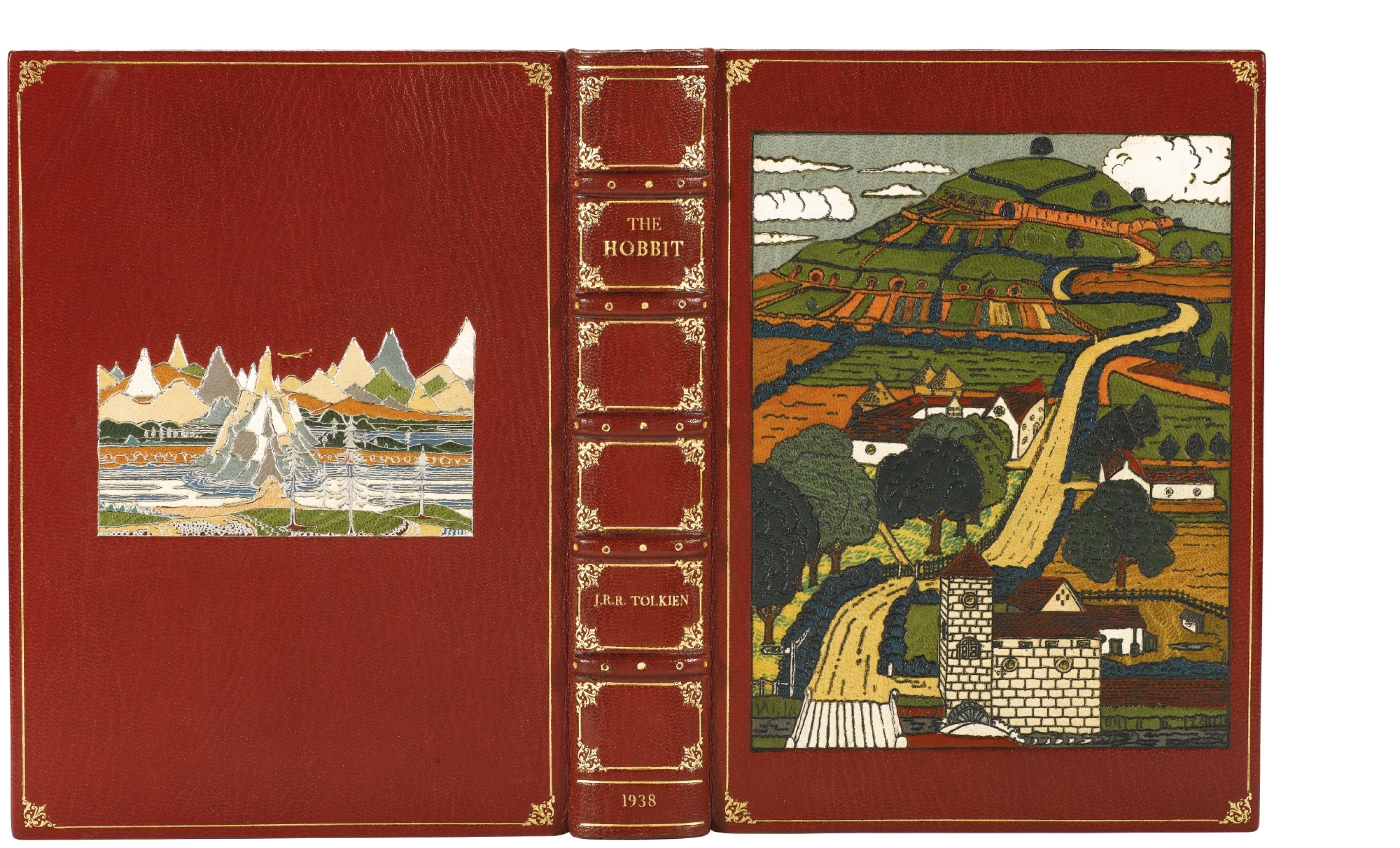
The spine is gilt in compartments, and the binding is completed with red silk moiré endpapers and gilt edges, giving the book a strong and elegant presence. The use of vivid red morocco, combined with detailed onlays, creates a harmonious balance between decorative artistry and fidelity to Tolkien’s original visual language.
This finely bound copy demonstrates how later binders have continued to reinterpret Tolkien’s own designs, transforming a classic text into a highly collectible work of art while preserving the significance of the underlying edition.
The The Hobbit binding with a view from Bilbo’s round front door by The Evilrooster Bindery
The Evilrooster Bindery is owned and run by Abi Sutherland. She has been binding books since early 2002, specialising in traditional fine binding structures and leatherwork.
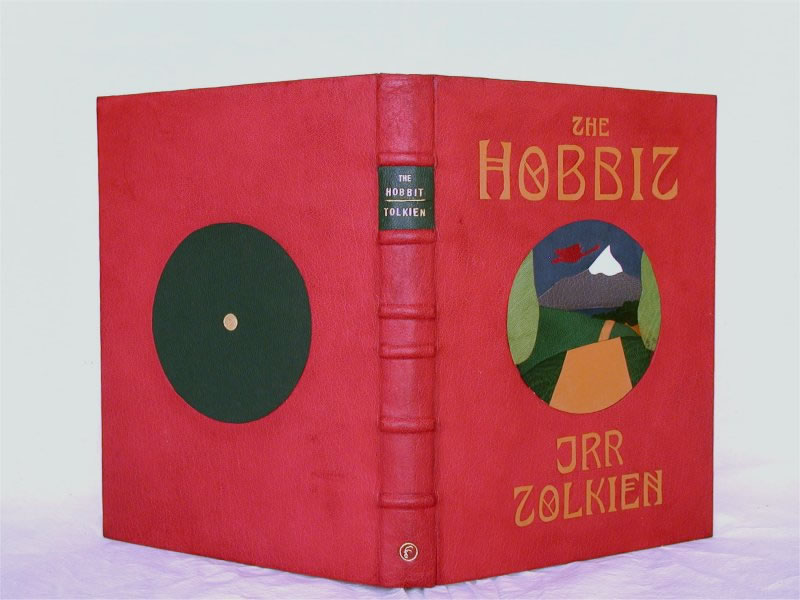
This fine-bound edition of Tolkien’s classic uses traditional techniques: sewn on raised cords, with a tight back and joints, hand-sewn headbands, and a drop-spine box for protection. It is covered in red leather, as Tolkien himself described. The onlaid panel and hand-designed lettering on the front cover are meant to lead the reader into the book, rather than simply decorate the exterior.
The front panel is the view from Bilbo’s round front door, showing the road leading over hills and through forests to the Long Lake and the Lonely Mountain, with the dragon himself hovering above. The rear panel shows that same door, closed, after the adventure is over. It was exhibited and sold at the Interaction Art Show in 2005 and signed by both the binder and the illustrator, Alan Lee.
Fantastic books in amazing artistic bindings by Pimax
The binders at Pimax in Poland specialise in handmade bookbinding of different editions and bibliophile books. They have created several fantastic bindings of The Hobbit. Every binding is made strictly according to the wishes of the client, so each rebound Hobbit can look completely different.
One thing remains certain, however: whether choosing the leather colour, style of decoration, or the binding structure itself, the result is one of high quality and fine craftsmanship.
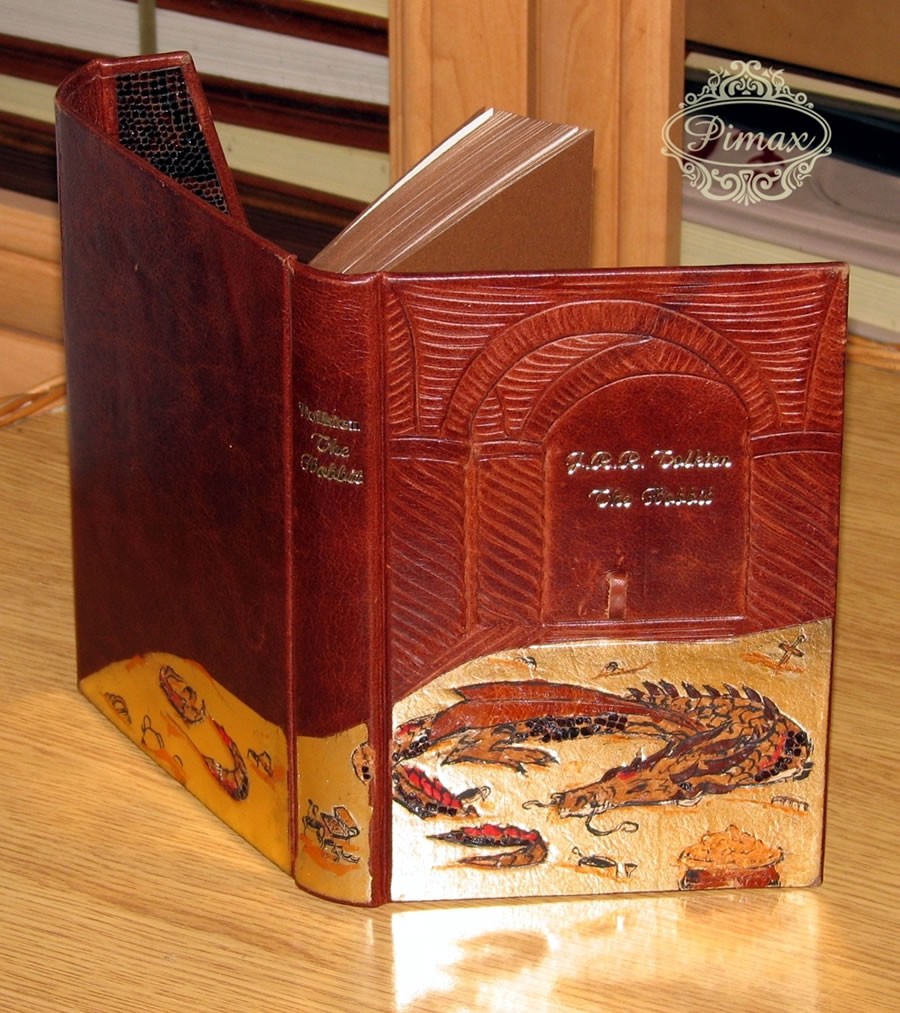
For example, this copy of The Hobbit, published by HarperCollins in 2007, received a very distinctive decoration: a bas-relief onlay enhanced with handmade tooling of Smaug the dragon.
The book can be closed like a folder. I am certain this copy will be treasured by its owner.
Polish Antiquarian Sobieski The Hobbit rebinding
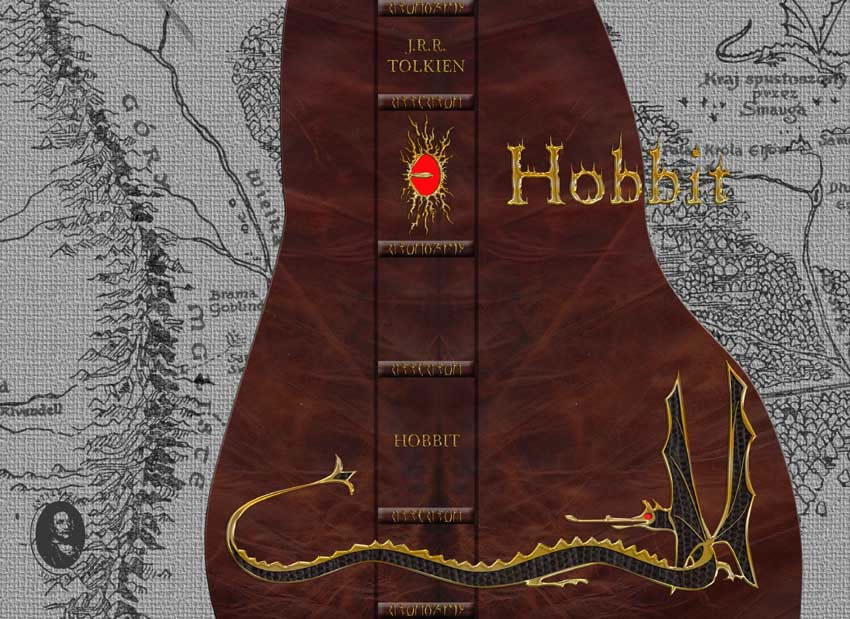
<p">At the beginning of 2010, Polish Antiquarian Sobieski teamed up with local bookbinders in order to push the art of bookbinding to a higher level. Alongside a copy of The Lord of the Rings, they also created the following remarkable rebound copy of The Hobbit, together with a matching clamshell case.
The elaborately decorated boards of both the book and the clamshell draw on motifs from Tolkien’s maps. The leather is decorated with a red eye and a dragon design by J.R.R. Tolkien. The raised bands carry gilt Elvish lettering, while the author and title are lettered in gilt on the spine.
As we can see in this article, many bookbinders use elements originally designed by Tolkien in order to decorate their fine bindings. Each tries to create a binding that is unique and memorable. I have seen several other pieces by binders who produce very original work, and I hope some will send over photographs of their own pieces of art to be added to this article.

Related Articles

In a quiet gallery in Oslo, two weathered pine planks carry one of the North’s greatest legends. Their carved figures—dragon, hero, sword, smith—once framed the doorway of Hylestad Stave Church in Setesdal. Around the year 1200, a Norwegian carver told the tale of Sigurd Fáfnisbani in wood long before it was written in Icelandic vellum.
Centuries later, J.R.R. Tolkien drew from the same deep tradition. His lectures, his retellings, and the design of his books reveal how this medieval doorframe echoed through his imagination. The journey from Hylestad to Tolkien is one of craft, storytelling, and the northern imagination carried forward across eight hundred years.

How do two minds from opposite sides of belief — one a devout Catholic mythmaker, the other a Norwegian pessimist — arrive at the same understanding of consciousness as a wound?
In this long-form reflection, written from the northern coast of Norway, Pieter Collier explores the unexpected dialogue between J. R. R. Tolkien and Peter Wessel Zapffe.
Through the fading light of The Silmarillion, he traces how Tolkien’s Elves, Fëanor’s fire, and the “long defeat” echo Zapffe’s philosophy of tragic awareness — and how both writers, in their own ways, transform despair into endurance, and endurance into art.

After years of quiet work behind the scenes, Tolkien collector Pieter Collier shares the story behind his move to Norway — a journey of illness, silence, and renewal. From his new home in Trollbergvika overlooking the Skagerrak, he reflects on why he withdrew, why he returns, and what lies ahead for the Tolkien Library and the lifelong work that began more than three decades ago.