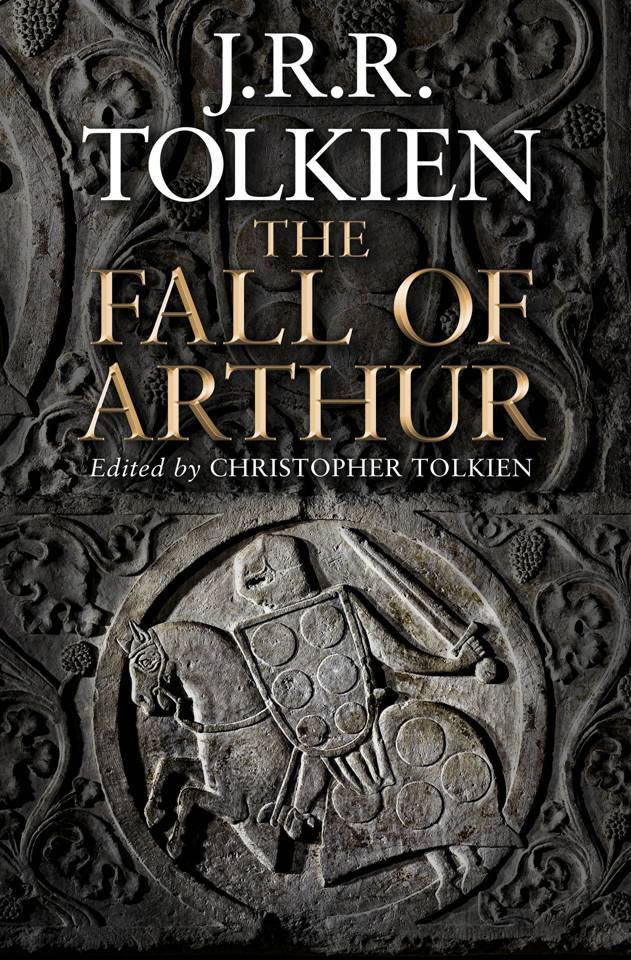
The Fall of Arthur: Pre-Publication Speculation
With the long-awaited publication of The Fall of Arthur approaching, anticipation is building among Tolkien readers and scholars alike. For those who have followed the scattered references to this unfinished poem over the years, its release promises not only a new work to explore, but a deeper insight into Tolkien’s engagement with the Arthurian tradition.
In this thoughtful piece, a longtime student of Tolkien’s work sets out to examine what we might expect—drawing on years of study to turn speculation into informed and testable ideas.
Part One; Writing the Poem - Sources and Ideas
It now appears certain that we will see the publication of a version of JRR tolkien's poem, The Fall of Arthur, sometime in the very near future. Why on earth, therefore, am I bothering to write about it before then? Well, both I myself and my frequent co-writer Alex Lewis have been intrigued by The Fall of Arthur for well over ten years now. With publication looming, our ideas have become not mere uncheckable speculation, however informed. Instead they do now stand in the position of a proper hypothesis, a statement or set of statements which can be proved or falsified by events. As such I think it is well worth setting out what we think about The Fall of Arthur, before publication. Did we get it right, or not?
Those of my readers who are old enough to remember similar speculation before the publication of The Silmarillion may well be shaking their heads with a wry smile. After all, practically nobody came anywhere near being right on that one.
However, we have carried a torch for The Fall of Arthur as a major and important work, both for itself and for the rest of JRR tolkien's writings, for a long time, and never quite gotten round to publishing our ideas.
In fact, the news of The Fall of Arthur's imminent apearance has delayed the book we were planning to issue this spring on the links between JRR tolkien's Arthurian writings and The Lord of the Rings. So, in the interests of letting people see what we have been up to in this area – and what some of the possibilities with regard to The Fall of Arthur are – we're willing to risk making a few predictions.
The existence of The Fall of Arthur has been known since the publication of Humphrey Carpenter's biography of JRR Tolkien. Carpenter devoted a paragraph to the work, and uniquely, he actually quoted from it – five-and-a-half lines of alliterative verse. Given the level of interest in The Silmarillion when Carpenter was writing, and the total concentration on the canonical 'Middle-earth' works in the published Letters, to have that much information about anything else in the biography surely indicates that it was of importance to JRR Tolkien himself. It's well worth quoting here what Carpenter had to say about The Fall of Arthur:
'Another major poem from this period has alliteration but no rhyme. This is 'The Fall of Arthur', tolkien's only imaginative incursion into the Arthurian cycle, whose legends had pleased him since childhood, but which he found 'too lavish, and fantastical, incoherent and repetitive'. Arthurian stories were also unsatisfactory to him as myth in that they explicitly contained the Christian religion. In his own Arthurian poem he did not touch on the Grail but began an individual rendering of the Morte d'Arthur, in which the king and Gawain go to war in 'Saxon lands' but are summoned home by news of Mordred's treachery. The poem was never finished, but it was read and approved by E.V. Gordon, and by R.W. Chambers, Professor of English at London University, who considered it to be 'great stuff - really heroic, quite apart from its value as showing how the Beowulf metre can be used in modern English'. It is also interesting in that it is one of the few pieces of writing in which Tolkien deals explicitly with sexual passion, describing Mordred's unsated lust for Guinever (which is how Tolkien chooses to spell her name):
His bed was barren; there black phantoms
of desire unsated and savage fury
in his brain had brooded till bleak morning
But tolkien's Guinever is not the tragic heroine beloved by most Arthurian writers; instead she is described as
lady ruthless
fair as fay-woman and fell-minded
in the world walking for the woe of men.
Although 'The Fall of Arthur' was abandoned in the mid nineteen-thirties, Tolkien wrote as late as 1955 that he still hoped to finish it; but in the event it remained unfinished.'
(Carpenter 1977; part IV, ch6)
Starting work on what even then was meant to be a book on the subject, I wrote almost ten years ago that, 'Slight as the evidence for The Fall of Arthur is, we firmly believe that this poem is of interest for much, much more than just the loves of Guinever and Mordred' – and I still firmly believe that. For a start, The Fall of Arthur is highly likely to be of literary interest in itself. Though the general downturn of interest in poetry across the 20th century means that JRR tolkien's work in this genre has never been looked at seriously even by favourable critics, The Fall of Arthur has an excellent chance of being a good poem, telling a strong story in an interesting way. This is backed up by the approval of both EV Gordon and RW Chambers, both among the most important figures in English studies of their day. Their opinions deserve to be taken seriously. We also know that Rayner Unwin – a noted publisher in his own right and a longtime friend of Tolkien – wanted to see The Fall of Arthur printed. In a speech at the formal dinner at the Tolkien Society's Annual General Meeting in Cambridge in 1990, Rayner Unwin said; '...I hope that will be the year, 1992 in fact, when Christopher [Christopher Tolkien] can have his sabbatical and get on with some of the other things he needs to do – I want him to do rather – like the book of his father's long non-Middle-earth poems, “The Fall of Arthur” and the new Volsungasaga and a few other things. These exist and they need to be brushed up and put into a volume...'
(Armstrong 1998, p.8 – Few after-dinner comments can have been quite so tantalising as that 'a few other things'!)
Unfinished', too, need not imply that this is a mere fragment. Firstly, the size of the equally 'unfinished' poems on 'Silmarillion' subjects would suggest that The Fall of Arthur could be substantial in size. Secondly, if Tolkien was willing to let someone like RW Chambers, who was not it seems a particularly close friend, read The Fall of Arthur, and if Chambers was impressed by it, then the piece must have already had a coherent structure which would be clear to a reader. What we can say for certain is that in the opinion of three people whose judgement deserves respect, The Fall of Arthur is a good poem; and for them to think that, in all probability it has to be a sizable and structurally coherent work, even if technically 'unfinished'.
Secondly, we believe that The Fall of Arthur cannot be considered in isolation from tolkien's work on The Silmarillion-tradition and Middle-earth, but must be looked at alongside and intertwined with the better-known works.
Not only is it a virtual certainty that tolkien's work on the Arthurian legends had an impact on LotR, as we will see. It is also very possible that if he returned to The Fall of Arthur after LotR was completed, tolkien's experience in creating 'Middle-earth' as we know and love it had an effect on his presentation of the Arthurian story.
In just this way, the tale of the Fall of Gondolin (the very first piece created all the way back in 1916/17) had an impact on the way Tolkien wrote about Minas Tirith in LotR; and Minas Tirith in turn went on to affect Gondolin in Of Tuor and His Coming To Gondolin, published in Unfinished Tales. Even The Silmarillion is too often forgotten in discussions of The Hobbit and The Lord of the Rings, though such things as tolkien's use of medieval sources cannot be properly understood without it.
Fewer writers still bother to look at tolkien's non-Middle-earth work, even though it too is a vital part of the making of the writer who created The Hobbit and The Lord of the Rings. One who has considered this area is Professor Tom Shippey, who in 'JRR Tolkien: Author of the Century', devotes his sixth chapter to tolkien's poetry and short fiction. For some reason Shippey did not look at The Fall of Arthur, though he did talk about another then-unpublished piece, tolkien's work on the story of the Volsungs.
More generally, everything which we know about tolkien's complex attitude to the Arthurian stories suggests that they could have been an important influence on his work. Looking at the process of writing from a practical angle, authors typically learn just as much (if not indeed more) by what they consider to be other people's mistakes as by their successes. If Tolkien thought that the various medieval and modern writers of Arthuriana had gotten some things right and others drastically wrong, then that example is likely to have influenced what he did in writing his own stories. This is the 'negative influence' which Diana Glyer wrote percipiently about in her recent book on the Inklings, The Company they Keep. It is a hugely underestimated force in any author's creativity. We can see this happening in tolkien's reactions to Shakespeare, as explained by Tom Shippey in the fourth chapter of 'Author of the Century'. On that evidence, Tolkien was quite capable of appreciating works, even liking them, and yet still seeing what, from his point of view, were important mistakes or missed opportunities on the part of the original author – points and ideas that he could then pick up on in his own work if he so wished. Indeed, Tolkien could have seen exactly this 'negative influence' operating within the central medieval Arthurian tradition, in the work of Chrétien de Troyes himself. Chrétien evidently disliked aspects of the stories of Tristan and Lancelot, material he was asked to work on and had to keep in pretty much its original shape. He went on to write Cliges out of that irritation, taking those problems and turning them into possibilities for something new and quite different.
In writing his own version of the Arthurian legends, Tolkien would also have been able to explore ideas which would be important later – to take only one example, wizards as 'serious' rather than comic characters. Without The Fall of Arthur as part of the background, much of The Lord of the Rings can seem unprecedented in tolkien's work, a sudden and sourceless change. Add in the unpublished Arthurian work to what Tolkien had already written, and things will surely take on a different complexion. The very reasons which have led Alex and myself, among others, to campaign for The Fall of Arthur's publication are the ones which make us await it eagerly now.
One of the major points which may or may not be resolved in the imminent publication of The Fall of Arthur is that of dates and numbers of versions. Carpenter ascribes it loosely to the 1920's and early '30's, though shoehorning anything else of any length into the picture Christopher Tolkien has already given us in the HoMe series of his father's work during this time looks difficult. Furthermore, Carpenter's mention of the point that JRR Tolkien wished to finish and publish the poem in 1955 could well reflect a second phase of work, exactly as was the case as with the versified forms of The Silmarillion–tradition tales of Beren and Lúthien and Túrin Turambar. Beyond even that, we suspect there might well be a prose version, or fragments of such, lurking behind certain passages in LotR. It is more obvious in the early versions presented in the relevant HoMe volumes, but even in the published book, there are things which still, to our minds, suggest 'internal borrowing' from The Fall of Arthur. If I am slightly cagey about saying what, forgive me – we still want to publish that book, and our conclusions are therefore 'under wraps' as work-in-progress! What I am happy to put forward as an hypothesis is that there are at least two verse versions of The Fall of Arthur, one from the 1920's and 30's and one from the 1940's and 50's; and there may well be some prose work too, dating from the 'gaps' in the writing of LotR during the Second World War.
With The Fall of Arthur the question of dates is far from academic, because we already know that JRR tolkien's attitudes to the Arthurian legends were changing radically across the timespan in question. The evidence is in the manuscript versions of his famous essay On fairy-stories, as edited by Verlyn Flieger and Douglas A. Anderson (2008). What that remarkable papertrail shows with absolute clarity is that tolkien's attitude was shifting drastically across the period of the late Thirties and the Second World War. In one of the earliest versions, Manuscript A of 1938-9, on p.184 of the 2008 edition, we find the following:
'For while it seems moderately plain that King Arthur was originally an historical character, around whom in legend both other matters or stray bones of history (such as King Alfred's successful resistance against Danes) and of the higher and lower mythologies gathered; it can hardly be denied that Gawain is higher altogether: a mirror of humanity or human courtesy and true virtue. He is descended (if that is the word) from a figure more mythical, waxing and waning to his strength at noon like a sun hero.'
By the time of publication in the Charles Williams memorial volume, however (1947), the familiar text had appeared: 'It seems fairly plain that Arthur, once historical (but perhaps as such not of great importance) was also put into the Pot, there he was boiled for a long time, together with many other older figures and devices, of mythology and Faërie, and even some other stray bones of history (such as Alfred's defence against the Danes), until he emerged as a King of Faërie.' (Tolkien ed Flieger and Anderson 2008, p.46; emphasis mine).
In a struck-through page from Manuscript B (c.1940-3?) in the same group, Tolkien referred to the Arthurian stories as almost a cheat, as waking the desire to visit past time rather than Faerie:
'I must say I hoped or wished that some of the creatures of fairy-story were true – the hope or wish showing the absence of belief. In particular I had a deep longing to see and speak to a Knight of King Arthur's Court, whom I should have regarded much as Peredur did. But that is a special case; for owing to the accident of the deveopment of the Arthurian legend it was and became thus so presented largely as History. It was not quite fair.'
(Tolkien ed Flieger and Anderson 2008, p.235; underlining original.)
Part of the reason for this change of approach from mythic to historic may well be Charles Williams himself, whose Arthurian poetry is soaked in a highly personalised Christian-occult mythology. In order to differentiate himself, JRR Tolkien could most easily shift to a 'historical' Arthur.
ki
Another reason may be a man whom we can increasingly guess is an unsung yet important factor in the story of the Inklings; the philosopher and archaeologist RG Collingwood, collegiate colleague to first JRR Tolkien and latterly CS Lewis. It was almost certainly Collingwood's connections which resulted in JRR Tolkien being invited to deliver the Andrew Lang lecture which turned into On fairy-stories; TM Knox, the man who asked JRR Tolkien to do so, was Collingwood's former pupil and later, his professional executor.
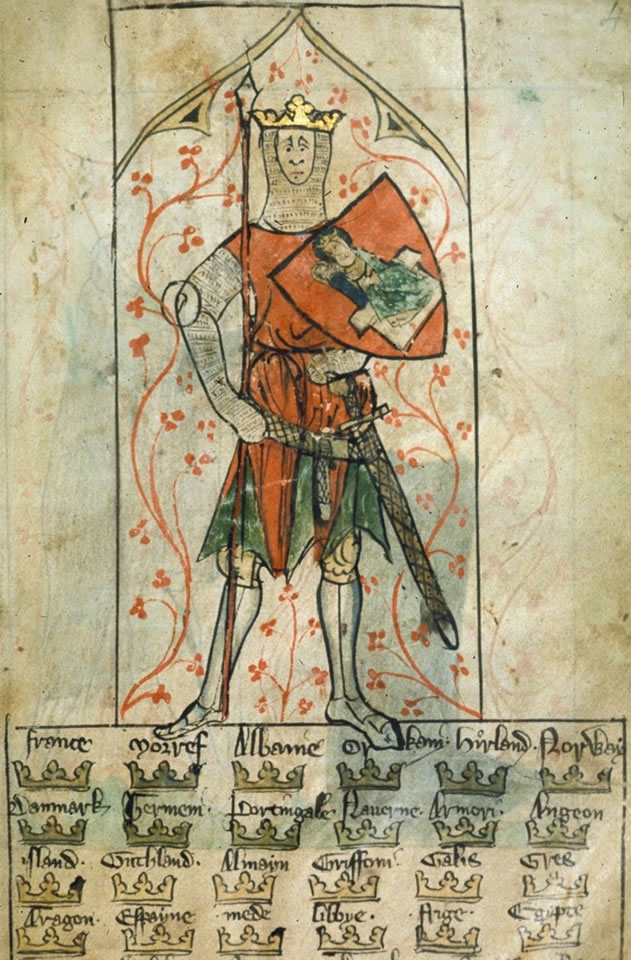
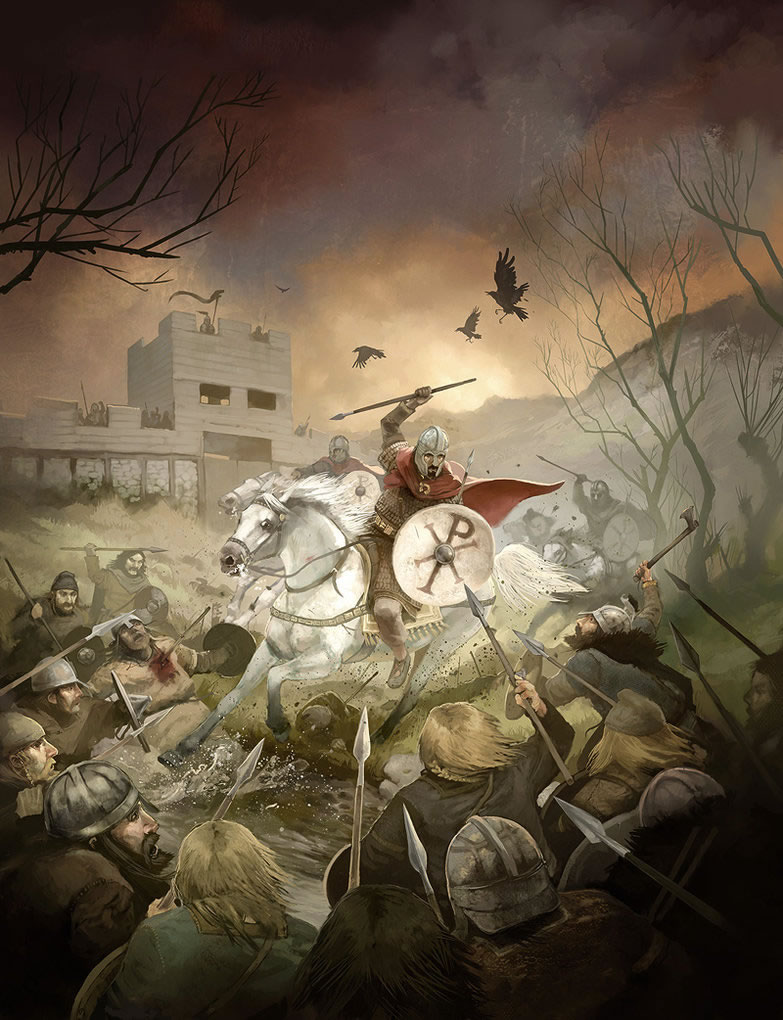
JRR Tolkien was one of only four people thanked by name in Collingwood's half of the first volume in a new Oxford History of Britain, Roman Britain and the English Settlements of 1936. This is important, because it was Collingwood's presentation of a possible 'historical Arthur' there which went on to have a massive impact on Arthurian fiction after the Second World War. We know that the Inklings were discussing some of Collingwood's ideas – what is recognisably his attitude to Surrealism crops up in the writings of Lewis, Williams and Tolkien, for instance. So it is reasonable to think that his powerful vision of an historical Arthur, comes Brittaniarum, leader of Late Roman cavalry, could have had an impact on Tolkien, just as it would on many later writers (if, that is, it wasn't the other way round... one of the most important reasons for publication of as much of the 'Fall of Arthur papers' as possible).
What might these changes tell us about The Fall of Arthur? Its story is likely to be much the same across whatever number of versions there may have been, as I’ll explain later, but the manner in which that story is treated is just as likely to have changed dramatically. We can, I believe, reasonably guess that an earlier, 1920’s and 30’s version of The Fall of Arthur would include a great deal more ‘mythic’ and fantastic material. It might well bear comparison in this respect to Beowulf, where JRR Tolkien famously argued for keeping the ‘monsters’ at the centre as drivers for a ‘mythic’ (spiritual) rather than ‘historic’ (political) reading of the story. It’s unfortunate that Tolkien’s poem dealing precisely with ‘the folkloric aspects of Beowulf’, Sellic Spell, is also still unpublished; it might be very useful as an indicator of how JRR Tolkien was looking at such material. Any version of The Fall of Arthur from the 1940’s or later, by contrast, is likely to be far more ‘historical’ in its treatment of the Arthurian legends and the world in which they were set. This, it should be noted, is also a directly parallel development to JRR Tolkien’s writings in the Silmarillion–tradition across the same period of time, from the confident mythological synthesis of the 1930’s to his search for some sort of historicist and realist approach in the post-Second World War era.
I have mentioned story, and want to turn to that now. From the very beginnings of looking seriously at The Fall of Arthur, it has been obvious to us that its major ‘source’ in terms of story was likely to be a Middle English poem as good as it is little-known, the Alliterative Morte Arthure. Given Tolkien’s known interest in Sir Gawain and the Green Knight, the alliterative Morte is the obvious ‘next step’. RW Chambers regarded the alliterative Morte as an ‘English epic’ on a par with Beowulf and Paradise Lost (ALMA p.524) and if the latter comparison would probably have been uncongenial to JRR Tolkien, the former would certainly have piqued his interest. An essay on the poem by one Angus McIntosh appeared in Davis and Wrenn’s ‘English and Medieval Studies Presented to JRR Tolkien’ in 1962. We also know that Tolkien’s friend and collaborator E.V. Gordon (together with E. Vinaver) wrote an article on the alliterative Morte in 1937. Finally and most importantly, there is evidence for JRR Tolkien’s knowledge of this poem in Tolkien and Gordon’s ‘Sir Gawain and the Green Knight’ of 1925. The Notes are sometimes a little unclear about which Morte Arthure they mean, but a number of quotes (as at p.91, n. to l.611) make it certain that the alliterative Morte is the one being referred to. Only direct citation will satisfy some, but for me the balance of probability indicates that Tolkien knew the alliterative Morte and knew it well.
The aliterative Morte tells the tale of Arthur’s invasion of the Continent in response to Roman Imperial attempts to bring him under subjection; how he is victorious against first the Governor of Gaul and then the Emperor himself, despite facing a mighty army assembled from every corner of the Empire; but in the moment just before his final triumph as he marches on Rome itself, Arthur discovers that his nephew Mordred and his queen Guinevere, have betrayed him; returning to try to reclaim his kingdom, Arthur not only meets his death but narrowly avoids moral disaster as well. The Alliterative Morte is long, has been academically contentious, and rejoices in some of the most wonderfully obscure vocabulary. It also has a strong plot, good description and unusual amounts of characterisation, and is an engaging, enjoyable tale to read. I can recommend Simon Armitage’s new translation, The Death of King Arthur, by the way, for those understandably put off by the original. Importantly, the Alliterative Morte comes as close as any single creative work does to exemplifying the English tradition of Arthurian thinking and writing, always more ‘historic’ in nature and centred on the King and Gawain, not Lancelot, Tristan and the Grail
The alliterative Morte itself has unclear yet definite connections with another and earlier Middle English poem, Layamon’s version of the Brut, or versified version of Geoffrey of Monmouth’s History of the Kings of Britain. Layamon was writing in a mode far more like Old English alliterative verse than that of the high-medieval revival of the form. His links backward were early recognised, and his probable influence forward on writers who can’t possibly have used the manuscripts we have is a telling warning of the unpredictability of survival (Hamel 1984; ALMA; etc). It would have been far less easy for JRR Tolkien to get hold of a good text of Layamon than of the alliterative Morte; as the Brut had then been published less often, but not impossible. As with the alliterative Morte, some evidence for Tolkien’s interest in Layamon appears in a volume dedicated to him (an essay on Layamon appears in the posthumous Festschrift volume co-edited by by Mary Salu, ‘JRR Tolkien, Scholar and Storyteller’ of 1979) while there is direct evidence of knowledge in the notes to ‘Sir Gawain and the Green Knight’ (Tolkien and Gordon 1925, n.39, p.81, etc). Layamon’s work is far harder to read in the original than the alliterative Morte, but in this area Tolkien would have definitely had an advantage with his knowledge of both Middle and Old English. At times, Layamon’s Arthur cheerfully mixes Celtic and Germanic attributes. In a set-piece ‘arming of the hero’ scene in the run-up to the Battle of Bath, we find that alongside the ‘Welsh’ shield Pridwen (misnamed from Arthur’s ship), spear Ron and sword Caliburne (which were known both to the author of Culhwch and Olwen and to Geoffrey of Monmouth), Arthur is wearing a hauberk of ‘elvish’ make, possibly forged by Weland’s son, and a helmet named Goosewhite which looks suspiciously like Beowulf’s, another product of the Weland workshop. Between them, we think it very likely that the Arthurian section of Layamon’s Brut and the Alliterative Morte Arthure were the major ‘sources’ for JRR Tolkien’s The Fall of Arthur.
However, also from the beginning, it was clear that if JRR Tolkien was using the Alliterative Morte as any kind of pattern or ‘source’, he had made at least one radical change. Carpenter gave us that information with his thumbnail description, ‘the King and Gawain go to war in ‘Saxon lands’’. Not the anti-Roman southern-European adventures of the Alliterative Morte, and every other writer from Geoffrey of Monmouth on through Layamon to Malory, but a northern venture. And one, moreover, which answers the criticism of Arthur and the Arthurian legends by one of the greatest writers in the English language. In his The History of Britain, first published in 1670, John Milton was particularly sceptical about Arthur’s Continental conquests, challenging the usual accounts on the grounds not just of historical plausibility but of military sense, saying thatArthur ‘much better had made War in old Saxony, to repress thir flowing hither, than to have won Kingdoms as far as Russia.’ (quoted in Lupack 2005, p.44) Now, Tolkien’s own knowledge of Milton may be debateable, but that of CS Lewis surely is not. And The Fall of Arthur was probably started at the very time when the two men were closest and collaborating most fruitfully, and when Lewis was either working on his own Arthurian narrative poem, Launcelot, or had very recently been doing so. We do tend to forget that both men were First World War veterans, former Army officers with whom such a practical criticism would weigh heavily and to whom it might provide an imaginative challenge, a ‘what if?’ of considerable interest. Therefore, I would suggest, Milton’s criticism could indeed have been a source of this known plot-thread in The Fall of Arthur.
Nowadays we tend to think of ‘historical Arthurs’ as a post-Second World War phenomenon, the province of the likes of Rosemay Sutcliffe, Alfred Duggan and, most recently, Bernard Cornwell. There were however writers taking an interest in this area between the two wars. The poet John Masefield (who was then important and much-read) used the idea in his Midsummer Night and Other Tales in Verse of 1928. This group of poems were deeply informed by a knowledge of the Welsh Arthuriana which few at the time could have matched. They included, besides works which attempt to create a realistic historical setting for Arthur, others on the theme of Arthur as ship-king which resonate with some of JRR Tolkien’s most persistent yet elusive ideas. If I may borrow a quote: ‘In ‘Badon Hill’ and ‘The Sailing of Hell Race’, Arthur’s prowess as war-leader and sea-captain is established, and Masefield is in his element. In the second of these poems in particular, realistic details of the voyage combine with the supernatural in a manner reminiscent of Coleridge’s The Ancient Mariner, as Arthur visits the three kingdoms of hell.’
(Taylor and Brewer 1983, ch.7, pp 228-9)
As far as academic attitudes go, a less dramatic version of Collingwood’s ideas was taken up by S. Frere and presented as established fact in the next great survey of Roman Britain, ‘Britannia’, in 1967. By then the ‘Camelot Research Committee’ had been in existence for two years, formed by archaeologists and Arthurian enthusiasts to promote archaeological exploration of the sub-Roman period. The high-water-marks came with the dig at South Cadbury hillfort from 1966-70, (given popular publication by Leslie Alcock in his 1972 book, ‘ ‘By South Cadbury that is Camelot’) and the publication of J. Morris’s ‘The Age of Arthur’ in 1973 (the author was a highly respected historian, but the result was closer in spirit to Geoffrey of Monmouth than anyone else). From the later 1970’s onwards this enthusiasm was replaced with an equal and opposite reaction which eventually led to the virtual disappearance of Arthur from academic studies of Britain between the Romans and Anglo-saxons, which we see today (Dumville 1977 and Hutton 2003).
Choosing a ‘more historical’ setting for Arthur and his knights was therefore an option for JRR Tolkien, even in the 1930’s. At the time, too, mythic accounts of Arthur were quite possible. If Tolkien was doing any work at all on The Fall of Arthur after the Second World War, any personal preference for a fifth-sixth century setting, and any wish to present a more ‘realist’, historically grounded view of the legends, would have been reinforced by the academic and literary attitudes which Tolkien would have seen around him.
So, we have seen what little we do know about The Fall of Arthur right now, and begun to explore what inferences can be drawn from this. I have explained that The Fall of Arthur is, potentially, an important piece for itself, and also for the links between it and Tolkien’s more familiar works. We can I believe say that the poem has likely sources exactly where we should look for them, in medieval English alliterative verse. I have also explained that how JRR Tolkien used this material would have been an individual response to the Arthurian theories of his own lifetime, changing in step wth the changes in his ideas which we can see in his already-published works. In the next section of this article, I go on to look at what we know about which characters Tolkien used, and what else we can guess from our knowledge.
Part Two; The Cast of Characters
Carpenter’s Biography gives us a basic cast-list for The Fall of Arthur; Gawain, Mordred, Guinever, and Arthur himself. However, these characters may not be the people we’re expecting. ‘What everyone knows’ about the Arthurian legends these days comes almost inevitably from Malory, who was working mainly (though not exclusively) with the French tradition. JRR Tolkien was a lot less Francophobe than he liked to make out, as Verlyn Flieger showed in a lecture of singular verve at The Return of the Ring in August 2012. However, all the signs are that as far as characters rather than methods go, his heart was with the English tradition. As Dimitra Fimi has shown us recently, JRR Tolkien also knew the Welsh Arthuriana very well indeed, and among this material, the oldest tale of all, Culhwch and Olwen is of particular interest as being very little affected by Geoffrey of Monmouth’s ideas in that other fiction bestseller from an Oxford scholar, The History of the Kings of Britain. We can say for sure that Tolkien knew Culhwch and Olwen , as he cites it in his lectrue English and Welsh, (Tolkien ed. Tolkien 1983, p.181) Further again, if Tolkien was in any sense looking at Arthur through historical lenses – even t
Related Articles

The Hylestad doorway tells Sigurd’s story in wood. There is a sword at the forge, a dragon, a horse carrying gold, and a man playing a harp among snakes. Each scene asks the eye to pick out a few details.
When The Legend of Sigurd and Gudrún appeared in 2009, one of those details reached the cover. I went back to the doorway and to my interview with Bill Sanderson to see what the book’s designers and illustrator had chosen to carry over.

Reading The Silmarillion after our move to Norway brought me back to Peter Wessel Zapffe. In The Last Messiah, a hunter comes to understand what it means for the animals he hunts to suffer. Tolkien gives his Elves centuries in which to learn what it costs to remember.
I follow that comparison through Fëanor’s refusal to break the Silmarils, Finrod’s conversation with Andreth, and the choice Galadriel makes before she leaves Lórien.

We arrived in Trollbergvika, across the fjord from Risør, on 1 September 2025. The move came after years in which I kept collecting and helping others with their libraries while finding less time to write. The books had to be packed, brought north and put in order again.
Looking back, I can see how much of the move was about finding a place for the work to continue. It began with opening the boxes.