
From Hylestad to Tolkien
The Hylestad doorway tells Sigurd’s story in wood. There is a sword at the forge, a dragon, a horse carrying gold, and a man playing a harp among snakes. Each scene asks the eye to pick out a few details.
When The Legend of Sigurd and Gudrún appeared in 2009, one of those details reached the cover. I went back to the doorway and to my interview with Bill Sanderson to see what the book’s designers and illustrator had chosen to carry over.
Look for the horse first. On the Hylestad portal, Grani carries away the dragon’s gold. On the 2009 HarperCollins cover, the horse comes forward out of a carving that goes on well past the edge of the jacket.
Then look at Gunnar’s harp. Its position at his feet helps us distinguish versions of the story. Bill Sanderson had a different problem when he opened his box of tools. He had to find lines that would make a scene recognisable on the printed page. The forge is the place where I would begin that comparison.
How the Sigurd story travelled from a Norwegian church doorway to a book jacket
A doorway between worlds
Two carved portal planks from Hylestad Stave Church preserve one of the North’s great heroic stories. Made around 1200 for a church in Setesdal, Norway, they bring together a smith, a sword, a dragon, a treacherous companion and a horse burdened with treasure. The church has gone, but its doorway survives in the University of Oslo’s museum collections.1
The doorway belonged to the church as a working entrance. The museum describes portals in terms of the passage from the outside to the interior. Looking at the Hylestad carvings in a photograph, I can see the whole surface at once. A person going through the doorway would have approached those planks at the scale of a body, with some scenes near the hand and others high above the eye. That is worth remembering when we turn from the doorway to the cover of a book.2
For a Tolkien reader, the figures offer an immediate point of recognition. This is the world of Sigurd and the Völsungs, a tradition Tolkien studied and reshaped in English verse. The connection became visible on a bookshop shelf in 2009, when HarperCollins published The Legend of Sigurd and Gudrún with a detail of the Hylestad carving on its cover.
That is the journey worth following: not a claim that this particular doorway inspired Middle-earth, but the meeting of medieval craftsmanship, Tolkien’s poetry and modern book design. A carving once encountered at a church entrance became a threshold to a book.
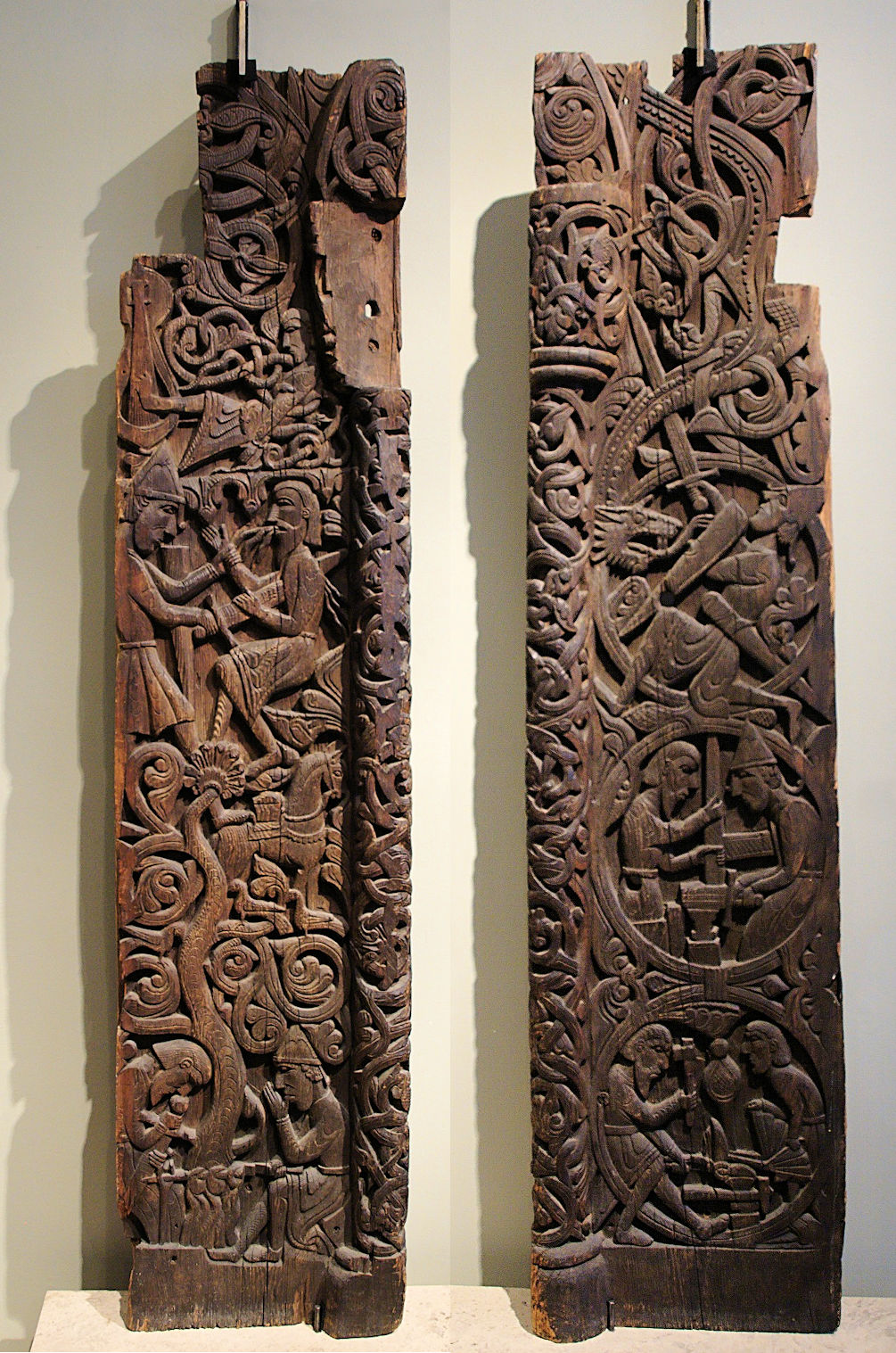
The surviving Hylestad portal planks. Their interlaced scenes preserve a narrative, not merely decorative dragon motifs.
A photograph can make these planks seem like pages laid side by side. They were, however, parts of a building: objects encountered with the whole body, not only with the eye. Their narrow, upright proportions belong to an entrance. Looking at them now, we have to imagine the missing architecture without pretending that we can reconstruct every detail of the original experience.
The surviving surface adds another dimension. The figures emerge from the timber through differences of depth, and their clarity changes with light and viewpoint. Pattern and narrative occupy the same space. A curve that first appears ornamental becomes part of a living creature; a small shape within the interlace resolves into a hand or a tool. This gradual recognition is one of the pleasures of looking at the portal. The story is present, but it asks for attention.
Reading the Panels
The sequence becomes legible once the eye adjusts. Regin at the anvil. Sigurd testing the sword. Fafnir curving above the hero. The roasting of the heart and the moment of understanding. The treachery of Regin. Grani bearing the burden of gold. Elsewhere, Gunnar plays his harp among the snakes. These are not interchangeable dragon motifs: they are recognisable moments in a story.
The following guide follows the narrative connections between the scenes rather than treating the two planks as a modern comic strip. Their arrangement belongs to the doorway, and not every episode in the larger legend is represented. The pleasure is to move between the particular gesture and the story it calls into memory.
1. Regin at the forge
First comes the work of making. Regin and Sigurd appear with the tools of the smith, and the anvil gives the scene its centre. Before the hero can face the dragon, a blade must be prepared. This is an unusually fitting beginning for a story told by a craftsman: courage depends upon something fashioned by hand.
In the legend, the making of Gram belongs to a history of broken inheritance and renewed strength. The blade is not merely equipment. It brings the past into the present and makes a future action possible. The woodcarver gives this preparation its own place. The forge is not swept aside in the rush to the famous encounter; it is part of what makes that encounter meaningful.
2. The sword is tested
The test against the anvil turns craftsmanship into proof. We do not need a written label explaining the sword’s exceptional strength: the relationship between blade and anvil carries the action. A moment that a storyteller might expand through sound and suspense is compressed into a visible arrangement.
Look at the economy of that decision. The carver has neither pages of description nor the duration of a spoken performance. The scene must identify itself. The tool, the gesture and the object struck do the work. Once recognised, they open out into the longer tale of the weapon and the hero who will wield it.
3. Sigurd confronts Fafnir
The dragon makes narrative and ornament meet. Its extended, curving body belongs to the visual life of the portal, while Sigurd’s sword gives that curve a dramatic purpose. The hero strikes from below. What might at first have seemed an intricate decorative creature becomes Fafnir at the moment of confrontation.
Here the doorway asks us to look twice: first at the pattern, then at the event within it. The monster is powerful partly because it occupies so much of the surrounding form. Sigurd does not stand outside the design as a detached illustration. His action is bound into the same narrow field. The story and the structure of the carving cannot easily be separated.
4. The heart and the birds
After the violence comes a small, decisive gesture. Sigurd roasts the dragon’s heart, burns his finger, and brings it to his mouth. Tasting the blood allows him to understand the birds. Their warning reveals that the danger has not ended with the dragon’s death.
This is one of the most rewarding scenes to linger over. A hand raised towards a mouth can look almost ordinary, yet it marks a transformation in knowledge. The birds are no longer background life. They become speakers, and Sigurd becomes capable of hearing what was previously closed to him. The hero survives not only by strength, but by attending to a voice beyond his own expectations.
5. Regin’s treachery and death
The smith who helped prepare the encounter now becomes a threat. The warning of the birds changes Sigurd’s understanding of his companion, and Regin’s death follows. The tale has moved from the obvious danger of a monster to the less visible danger of betrayal.
That turn prevents the portal from becoming a simple celebration of victory. The first scene brought the two figures together in work; this one breaks their relationship. A viewer remembering the forge encounters it differently after recognising the later scene. The narrative runs forwards, but understanding also travels backwards.
6. Grani and the burden of gold
Sigurd’s horse bears the treasure. The animal and its load make the result of the adventure visible, and this is the detail that later greets readers on the 2009 HarperCollins cover. What appears on a bookshop shelf as a striking piece of medieval ornament is a specific participant in the legend.
The word burden matters. Treasure promises success, but within the larger story its possession brings danger rather than security. Grani carries more than the reward for killing a dragon. For someone who knows the tale, the hoard already contains the shadow of coming disaster. The quiet image can therefore be as ominous as the violent one.
7. Gunnar in the snake pit
At the top of the left-hand plank, Gunnar plays a harp with his toes among the snakes. This is not Brynhild’s awakening. It belongs to the later tragic world of the Niflungs, extending our view beyond Sigurd’s encounter with Fafnir.
The presence of Gunnar changes the scale of the whole. The portal brings a dragon-slayer’s adventure into contact with the consequences that surround the wider family story. Music and danger occupy the same confined space. The harp does not make this a peaceful conclusion: it gives the struggle another form, held within the same carved language as the forge and the sword.3
Together these scenes show how much a small number of images can hold. The carving is not a complete visual transcription of the Völsunga saga. It is a telling in its own right, shaped by available space, recognisable episodes and the possibilities of timber. Its gaps invite the viewer to remember, ask and return. In two slender planks, the old story remains capable of unfolding.
The placement of the harp is one of the details I would show somebody who had never read the story. In Atlakviða, Gunnar strikes the instrument with his hand. In the Völsunga saga, he is bound and plays with his toes after Gudrún sends him a harp. The Hylestad carver puts the instrument at the feet. In Tolkien’s New Lay of Gudrún, Gudrún still sends the harp and the music puts the snakes to sleep, as in the saga. Christopher Tolkien points out that his father gave Gunnar the use of his hands, following Atlakviða. I would keep a finger at that page while looking at the portal. The cover of the book brings the carving to Tolkien’s readers, and the poem inside gives them another way to see Gunnar in the pit.4
A heroic legend on a Christian threshold
Why place Sigurd on a church doorway? The question is more interesting than a simple opposition between pagan story and Christian building. Hylestad shows that an older heroic tradition could remain visible within a Christian setting.
The local church’s account of the portal suggests that the dragon fight could be understood in Christian terms. A struggle with evil, the danger of greed and the consequences of betrayal offer possible points of contact. Yet these are interpretations, not a surviving statement of the carver’s intention. We should not assume that every medieval viewer understood each figure in precisely the same way.
The doorway itself gives the encounter a particular force. A person entering the church passed a familiar story on the way into a sacred space. The old tale was neither simply erased nor left untouched: its setting invited it to be read again.5
For a modern Tolkien reader, that coexistence is suggestive. Older heroic narratives can survive changes of belief, language and audience. Their meanings are not fixed once and for all. The Hylestad panels make that process tangible, although they do not establish a direct source for any particular scene in Tolkien.
We should leave room, too, for the story’s appeal as a story. A memorable hero, a dangerous beast and an act of betrayal need not lose their narrative force because they appear in a religious setting. To reduce every detail to a fixed moral equivalent would make the carving less complex than the tale it preserves. The Christian doorway and the heroic narrative are both part of the object’s history; neither needs to cancel the other.
The image of a threshold is useful here because it allows more than one meaning to remain in view. Outside and inside, inherited memory and present belief, familiar figures and new interpretations meet at the same place. This is a way of reading the object, rather than a claim to recover exactly what an anonymous craftsman thought. It also explains why the portal remains interesting to people approaching it from very different starting points: art, religion, architecture or literature.
Tolkien’s northern inheritance
Tolkien’s interest in Sigurd began long before the publication of his own poems. In On Fairy-Stories, recalling his childhood reading, he singled out “the nameless North of Sigurd and the Völsungs, and the prince of all dragons.” That attraction developed into sustained scholarly and creative work.
Christopher Tolkien tentatively dated the two poems collected in The Legend of Sigurd and Gudrún to the early 1930s. They draw principally on the Poetic Edda, with the prose Völsunga saga also relevant to their reconstruction of the story. They are new poems in modern English, not straightforward translations.6
The two titles are The New Lay of the Völsungs and The New Lay of Gudrún. Their short, alliterative stanzas seek the concentration of Old Norse verse. Christopher’s 2009 edition provides commentary and material from his father’s lectures, allowing readers to encounter both the poet and the scholar.
It is tempting to draw a single straight line from oral story to carved wood, then to manuscript and finally to Tolkien. The history is less tidy. Stories circulated in different forms, and a carving is not necessarily an illustration of the particular text that happens to survive. The panels and the poems are better understood as different witnesses to a shared tradition.
This distinction does not weaken the connection. It makes it richer. A woodcarver and a poet each had to decide which moments to bring forward, how much to leave unstated, and how to give inherited material a new shape. Their works can illuminate one another without our needing to claim that Tolkien stood before this doorway or used it as a source.
Different crafts, a shared act of storytelling
The comparison between carving and poetry becomes most rewarding when we attend to their differences. A poem unfolds through time. The reader moves from word to word, and sound can bind one line to the next. The carved panels offer several moments together. The eye can return to a figure, linger over a detail or move between episodes in an order of its own. Neither medium simply duplicates the other.
Both nevertheless depend on selection. The carver cannot show every conversation, motive and consequence. The poet cannot rely on an image to make a gesture immediately visible. Each must decide what will carry the greatest weight. A sword raised over an anvil and a compact stanza are not the same kind of thing, but each can concentrate an action into a form that stays in the memory.
This is what it means to speak of wood holding a story. The timber does not contain the entire legend, any more than a book cover contains the book. It gives the story a durable point of recognition. The reader or viewer supplies something as well: remembered episodes, a sense of danger, perhaps the knowledge that an apparent victory will not protect the characters from later loss.
It would be too neat to call ornament visual alliteration, as though the two arts followed identical rules. Yet, as a comparison, repeated curves and repeated sounds can help us notice the discipline of each craft. Form is not merely an attractive surface added after the story has been told. It helps determine how the story is received. At Hylestad, the narrow space and interlaced composition shape our encounter; in Tolkien’s poems, the pressure of the stanza shapes the telling.
For that reason, the poems are worth approaching as poems, not only as a store of possible sources for Middle-earth. A reader looking exclusively for an early Smaug or a familiar heroic situation may overlook the particular achievement of this work. Reading slowly, or hearing a passage aloud, brings another question into focus: how does an English poet make an inherited northern story sound newly present?
The Return in Verse
When the story returns in Tolkien’s English, it does not return as a museum label or a prose explanation. It returns as verse. That distinction is central to the achievement of The Legend of Sigurd and Gudrún. Tolkien was not simply making an old plot accessible to a new audience. He was finding a form in which the inherited story could exert its force again.
The short lines ask to be heard. Stress, pause and alliteration work together, giving individual words a weight that a leisurely paraphrase cannot reproduce. A reader accustomed to the expansive movement of The Lord of the Rings encounters another Tolkien here: concentrated, abrupt, and willing to leave space around an action rather than explain away its severity.
The northern world is stern and stoic, with beauty and sorrow bound together. It is a useful description of the experience of reading these poems: beauty does not arrive after suffering has been resolved, but remains entangled with it. The reader feels both the strength of the form and the vulnerability of the people within the story.
The connection with Hylestad becomes particularly illuminating at the forge. In the wood, an anvil and a gesture stand for the making and testing of the sword. In verse, the action can be carried by stressed words and the pressure of a short line. Neither medium needs to reproduce every incidental detail. Both trust a strongly shaped moment to hold more than it explicitly displays.
We can follow the same movement through the dragon fight and the roasting of the heart. Confrontation gives way to knowledge; knowledge reveals betrayal. In a broad plot summary these may become merely successive events. In a carving or a stanza, each must be made present. A small action—the finger raised towards the mouth—can therefore become as important as the sweep of a sword.
This is where comparison should slow us down rather than hurry us towards a conclusion about influence. Place the scene beside the poem and ask what each makes us notice. The carving gives bodies a position in a bounded field. Verse gives actions a rhythm and voices a succession. One lets the eye revisit several moments at once; the other lets a pause fall between them. Their difference is part of their conversation.
Christopher Tolkien’s editorial work makes that conversation possible without concealing the complexity of the sources. The poems are presented alongside commentary and discussion, so the reader can pass from the immediate sound of the verse to questions about its construction. The scholar’s attention and the poet’s imagination are not competing activities. Here they become two ways of listening closely to the same inheritance.
There is a further reason not to stop with the dragon-slayer. The title names Gudrún as well as Sigurd. Her suffering and the later course of the tragedy keep the book from closing upon a single heroic triumph. Gunnar’s presence on the portal offers a comparable widening of attention: the famous encounter with Fafnir belongs to a world in which victory over a monster cannot protect human relationships from destruction.
Read aloud, the poetry also returns something that a silent photograph cannot supply: breath. The page determines where the eye moves, but the voice makes the rhythm an event. It is not necessary to reconstruct an imagined medieval performance to experience this. A few stanzas read carefully are enough to reveal that the form is doing work which a synopsis leaves behind.
Wood and verse thus preserve more than information. They preserve ways of meeting a story. The Hylestad craftsman gave the legend a durable visual shape; Tolkien gave it a renewed English cadence. The return is not a repetition without change. It is the old material taking on the discipline of another craft, and becoming present through that discipline.
Northern Courage Re-forged
The moral atmosphere of this encounter is larger than the dragon fight. In his discussion of Beowulf, Tolkien took seriously the courage of those who persist without an assurance of final victory. The attraction of the northern heroic world lies partly in that refusal to make success the sole measure of worth. A deed may matter even when the world in which it is done remains perilous.
This does not mean that every act of defiance is wise, or that the legends offer uncomplicated models for conduct. Pride, loyalty, love and revenge can become entangled. A story which honours courage can also expose the disastrous consequences of a person’s choices. That tension is one reason these narratives retain their depth after the outline of the plot has become familiar.
For Tolkien readers, Túrin and Glaurung provide an especially suggestive comparison with the older dragon-slaying tradition. A mighty adversary is confronted, but the destruction of the monster does not simply mend the hero’s life. The comparison is most useful when it opens questions about knowledge, pride and tragic consequence, rather than reducing one story to a renamed version of another.
At Hylestad, the movement from forge to dragon, from birds to betrayal, makes a related demand upon our attention. We are not looking at courage isolated from its consequences. The gold remains dangerous; the relationship with Regin breaks; Gunnar’s ordeal carries the eye into a wider tragedy. The heroic moment is held inside a world that cannot be made safe by a single stroke.
That is why the panels and Tolkien’s poems reward return visits. What first appears to be the clearest episode—the hero and the dragon—becomes less self-contained each time we recognise another connection. The story grows around the remembered image. It is possible to admire the deed and still feel the sorrow which surrounds it. The northern imagination has room for both.
The doorway becomes a book cover
The most direct link is the 2009 publication itself. The HarperCollins front cover shows Grani, Sigurd’s horse, carrying the treasure, with birds and interlaced carving around him. It does not show Sigurd striking Fafnir. That distinction matters when we compare the physical object with the design of the book.
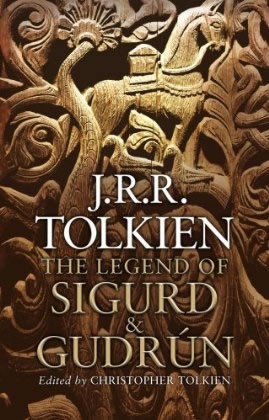
The 2009 HarperCollins cover. Grani and the treasure connect the book visually with the Hylestad portal. Cover image from Tolkien Library’s contemporary publication archive.
For collectors, the cover is more than an attractive wrapper. It supplies a visual route back into the story and the material culture through which that story has travelled. Someone who first meets the carving on a dust-jacket may later recognise it in Oslo; someone who knows the portal may approach Tolkien’s poems with a different sense of their inheritance.
The medieval object has not become a Tolkien artefact in retrospect. It retains its own history. The book creates a new relationship with it, bringing two independent acts of storytelling into the reader’s hands.
There is a collector’s pleasure in following that relationship closely. Place the cover beside a photograph of the complete portal and find the selected detail. What has been brought forward? What has disappeared beyond the crop? On the book, lettering and title direct our attention; in the wider photograph, the same figure belongs to a larger arrangement. Recognition becomes a small act of discovery rather than a vague impression of something medieval.
This is also a reminder to be precise about editions. The connection discussed here is with the illustrated 2009 publication and the HarperCollins cover shown above; it should not be assumed that every later edition or translation uses the same design. Jackets, bindings and illustrations form part of a book’s publication history. Recording them carefully allows us to distinguish Tolkien’s text from the different visual ways publishers have introduced it to readers.
A good collection preserves those distinctions. The ordinary dust-jacket can be as informative as the more conspicuous features of a deluxe binding. It records a choice made at a particular moment: which image should greet the reader, and what kind of past should the book appear to open? In this case, the answer leads beyond the publishing house to an actual medieval object, whose details can still be examined.
Bill Sanderson: from carving to printed illustration
The connection continues inside the book. When I interviewed Bill Sanderson for Tolkien Library in April 2009, he explained that he had worked closely from photographs of the old Norse carvings supplied as reference material. His aim was to carry their visual strength onto the printed page.
Sanderson’s scraperboard technique makes this especially fitting. Instead of drawing dark lines onto a light surface, he scratched through a black coating to reveal white beneath. The resulting images are new drawings, not photographs or mechanical copies of the wooden reliefs. Nevertheless, the act of cutting away a surface gives the process a suggestive kinship with carving.
He also clarified an important distinction: he had drawn a possible cover image, but expected a photograph to be used instead. We should therefore distinguish the photographic dust-jacket from his black-and-white illustrations within the volume.
Open the book to the forge and then go back to the photographs of the planks. The dark parts of the carving depend on where light falls on the raised wood. In the drawing, Sanderson had to decide where to make every light mark. Put the two side by side and the anvil is still an anvil. The lines that make the arm and tool readable at the size of a printed page are the illustrator’s own work.7
The interview gives us something firmer than a general resemblance between medieval ornament and modern fantasy design. Here an artist describes the reference material and the working process. The Hylestad connection belongs demonstrably to the illustrated edition, even where a direct influence on Tolkien’s own writing cannot be established.
The change of medium invites a closer comparison. A photograph retains the uneven surface and shadows of the relief. A black-and-white drawing must find another way to make the forms legible. Looking between them, we can ask which contours carry recognition and which details belong specifically to the material. Sanderson’s account makes that comparison a question about artistic decisions, not merely a hunt for matching shapes. The modern illustrator becomes another participant in the story’s transmission, with a craft and a viewpoint of his own.
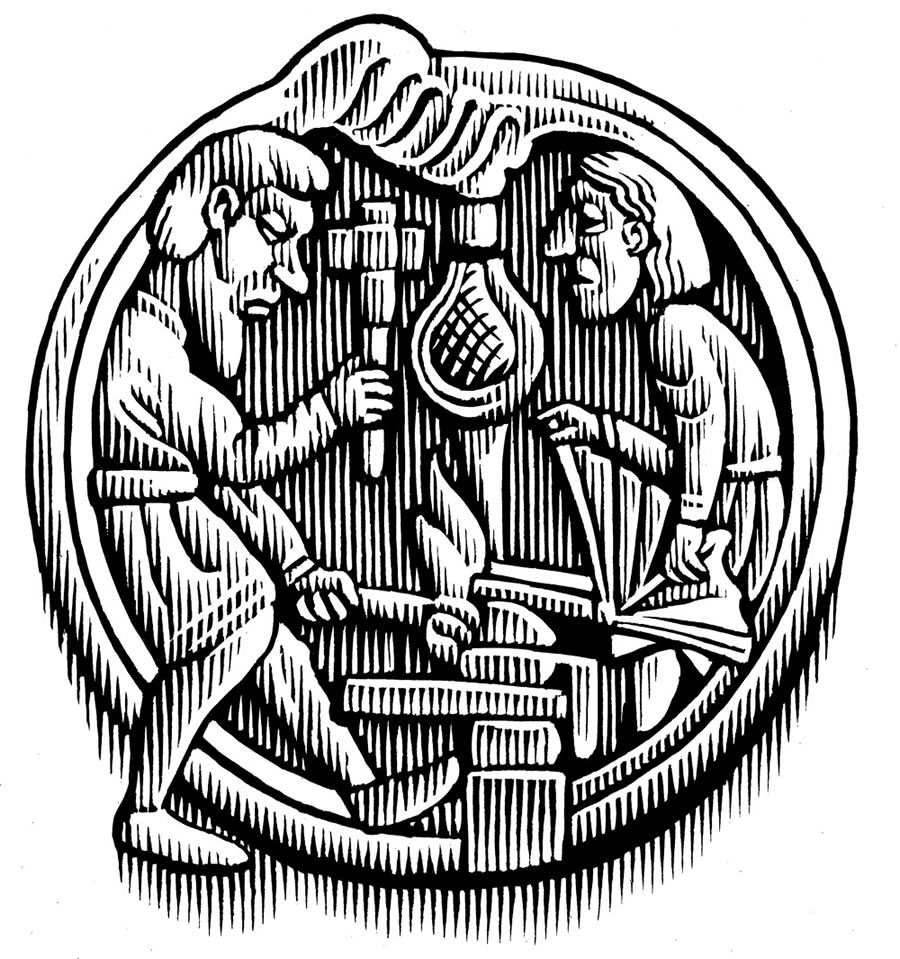
The forge scene translated into black and white by Bill Sanderson. Illustration reproduced in Tolkien Library’s contemporary coverage of the 2009 book.
Read the original interview with Bill Sanderson for his account of the commission and technique.
A living connection with Norway
For me, this meeting of books and objects is a reason to think about Tolkien in Norway without reducing the relationship to a claim about landscape. It is easy to look at a mountain, a forest or a wooden building and find something that feels like Middle-earth. That response can be genuine and moving. It is not, by itself, evidence that a particular place was Tolkien’s model.
Hylestad offers a different starting point. Here we can identify the object, recognise its narrative, examine the book cover and hear from the illustrator. The connection is made through things that can be looked at and sources that can be read. From that foundation, a more personal response becomes possible without having to carry the burden of a historical claim it cannot support.
Norway’s carved heritage belongs in this conversation alongside the written tradition. A manuscript and a portal preserve different kinds of evidence. One gives us words and their sequence; the other gives us figures, gestures, material and the relationship between a narrative and a building. Looking at both expands our sense of what the survival of a story can mean.
It also changes the experience of returning to Tolkien’s book. The cover ceases to be an anonymous piece of ancient decoration. Grani becomes a recognisable figure, the surrounding pattern part of a larger work, and the distance between the medieval object and the modern edition something we can trace. The pleasure lies in that movement of attention: from the book to the carving, and then back to the book with more to notice.
A Northern Benediction
The return in verse leads back to the wood. Tolkien’s verses gather the story into a handful of elemental images:
“Of sword and serpent,
of fire and gold,
and the doom of men.”
J.R.R. Tolkien, The Legend of Sigurd and Gudrún.
Read beside the Hylestad panels, those words bring the eye to what has remained constant through all the changes of medium: the made weapon, the dangerous creature, the forge, the treasure, and the human cost. They do not supply an inventory of every scene. They gather the atmosphere in which the scenes acquire their force.
The anonymous craftsman and the twentieth-century poet meet here in restraint. Neither needs an excess of explanation to make danger felt. A hand, a blade, a loaded horse; a stressed word, a pause, a short line. What is left unsaid or uncarved is not necessarily absent. It may be the part of the story that the reader brings to the encounter.
There is something fitting in calling this a benediction, provided we do not mistake it for an easy reassurance. The legend does not promise that the worthy will escape grief. Its gift is a form in which courage and sorrow can be contemplated together. The carving holds the moment; the poem lets it sound; the reader carries it away.
For me, this is the most enduring connection between Norway’s carved heritage and Tolkien’s literary one. It is not simply a likeness between a medieval dragon and a modern illustration. It is the possibility that a story can survive by being made carefully again: not flattened into a message, but given enough shape to retain its difficulty, beauty and life.
The threshold remains
Look closely at the Hylestad panels. The story has not survived unchanged, but it has remained capable of being told again.
In Tolkien’s poems it finds another rhythm. On the 2009 cover it returns to the carved figure. In Sanderson’s illustrations it passes through another artist’s hand. These are not interchangeable versions, and that is precisely what makes their relationship worth looking at.
The carver is long gone, yet his choices remain: the depth of a cut, the turn of a curve, the moment in which an action becomes recognisable. The story has not ended; it has changed languages. A modern reader brings the book to the carving, and the carving returns the reader to the book with another kind of attention.
Perhaps that is the most useful way to close the circle. Not by claiming that all northern art says the same thing, but by allowing these particular works to remain distinct and close. The planks belong to a Norwegian church; the lays belong to Tolkien’s work with an inherited poetic tradition; the illustrations belong to another artist’s hand. Their meeting gives us more to see, not less.
The doorway that once admitted a congregation now invites a different kind of entry. Open the book, look back at the wood, and the distance between Setesdal and the reading desk becomes a little smaller.
Sources and further reading
Books and primary texts
The books below provide the literary and art-historical background to this essay. The web references that follow offer accessible documentation and contemporary publication material; they supplement rather than replace the printed sources.
- J.R.R. Tolkien, The Legend of Sigurd and Gudrún, edited by Christopher Tolkien. London: HarperCollins, 2009. The principal text for the discussion of Tolkien’s two lays, with Christopher Tolkien’s introduction, commentary and appendices.
- J.R.R. Tolkien, “On Fairy-Stories,” in The Monsters and the Critics and Other Essays, edited by Christopher Tolkien. London: George Allen & Unwin, 1983. Tolkien’s account of the imaginative attraction of Sigurd and the northern world.
- J.R.R. Tolkien, “Beowulf: The Monsters and the Critics” (1936), also collected in The Monsters and the Critics and Other Essays (1983). For the relationship between heroic courage, monsters and the religious setting of northern poetry.
- The Letters of J.R.R. Tolkien, edited by Humphrey Carpenter with the assistance of Christopher Tolkien. London: George Allen & Unwin, 1981. See the correspondence with W.H. Auden, including letters 295 and 299, for Tolkien’s discussion of his work on the northern lays.
- Völsunga saga, in Fornaldarsögur Norðurlanda, edited by Guðni Jónsson. Reykjavík: Íslendingasagnaútgáfan, 1954. The prose tradition against which the scenes and later retellings can be read.
- Ursula Dronke, editor and translator, The Poetic Edda, volumes I–III. Oxford: Clarendon Press, 1969–2011. In particular, the heroic material in volume I provides a scholarly route into the older poetry.
- Tom Shippey, The Road to Middle-earth. First published by George Allen & Unwin, 1982; revised edition, HarperCollins, 2003. For Tolkien’s philological method and the relationship between inherited language and creative work.
- Rudolf Simek, A Dictionary of Northern Mythology, translated by Angela Hall. Cambridge: D. S. Brewer; 2007 printing. A reference for the figures, names and traditions encountered here.
- Erla Bergendahl Hohler, Norwegian Stave Church Sculpture, two volumes. Oslo: Scandinavian University Press, 1999. For the wider sculptural setting of Norway’s medieval wooden churches.
The portal, publication history and illustration
- Ola Storsletten, “Hylestadportalen,” Store norske leksikon — identification and subjects of the carvings.
- Hylestad church brochure — the local history and interpretation of the portal.
- Christopher Tolkien on The Legend of Sigurd and Gudrún, Tolkien Estate — composition, sources and editorial context.
- Tolkien Library’s 2009 publication guide — contemporary cover and edition documentation.
- Pieter Collier’s interview with Bill Sanderson, 20 April 2009 — the illustrator’s own explanation of his work.
Footnotes
- Ola Storsletten, “Hylestadportalen,” Store norske leksikon, for the provenance and identification of the planks. Portal record ↩
- Museum of Cultural History, University of Oslo, “Stavkirkeportaler”, on medieval portal ornament and the transition from the outside to the interior of a church. ↩
- Ola Storsletten, “Hylestadportalen,” on Sigurd, Regin, Fafnir and Gunnar. Read the scene identifications ↩
- Atlakviða 34, in Henry Adams Bellows (trans.), The Poetic Edda (1923), with his note on hands and feet. Read the lay and note. Compare Völsunga saga, ch. 38, in William Morris and Eiríkr Magnússon (1870), University of Iowa transcription. J.R.R. Tolkien, The Legend of Sigurd and Gudrún, ed. Christopher Tolkien (HarperCollins, 2009), New Lay of Gudrún, stanzas 132–140 and commentary, p. 330. ↩
- Valle and Hylestad parish, Hylestad kyrkje, brochure on the church and portal. Original parish brochure (PDF) · Tolkien Library source notes (PDF) ↩
- Christopher Tolkien, introduction to The Legend of Sigurd and Gudrún (HarperCollins, 2009), on dating the lays and their Old Norse sources. The Foreword also identifies the carvings with New Lay of the Völsungs, V, “Regin,” especially stanzas 41, 45 and 48. Read Christopher Tolkien’s account ↩
- Pieter Collier, interview with Bill Sanderson, 20 April 2009. See his account of the Norse carvings, scraperboard and the choice of a photograph for the cover. ↩
Related Articles

Reading The Silmarillion after our move to Norway brought me back to Peter Wessel Zapffe. In The Last Messiah, a hunter comes to understand what it means for the animals he hunts to suffer. Tolkien gives his Elves centuries in which to learn what it costs to remember.
I follow that comparison through Fëanor’s refusal to break the Silmarils, Finrod’s conversation with Andreth, and the choice Galadriel makes before she leaves Lórien.

We arrived in Trollbergvika, across the fjord from Risør, on 1 September 2025. The move came after years in which I kept collecting and helping others with their libraries while finding less time to write. The books had to be packed, brought north and put in order again.
Looking back, I can see how much of the move was about finding a place for the work to continue. It began with opening the boxes.

The first Lord of the Rings I read was the Dutch hardback set I found in my brother’s old room. Years later I came across proofs of the same translation. By then I had begun to ask what a copy could tell me about the people who had made it and passed it on.
This is the story of the books, letters and Cor Blok paintings that changed the way I collect, and of the people who trusted me with their own libraries.